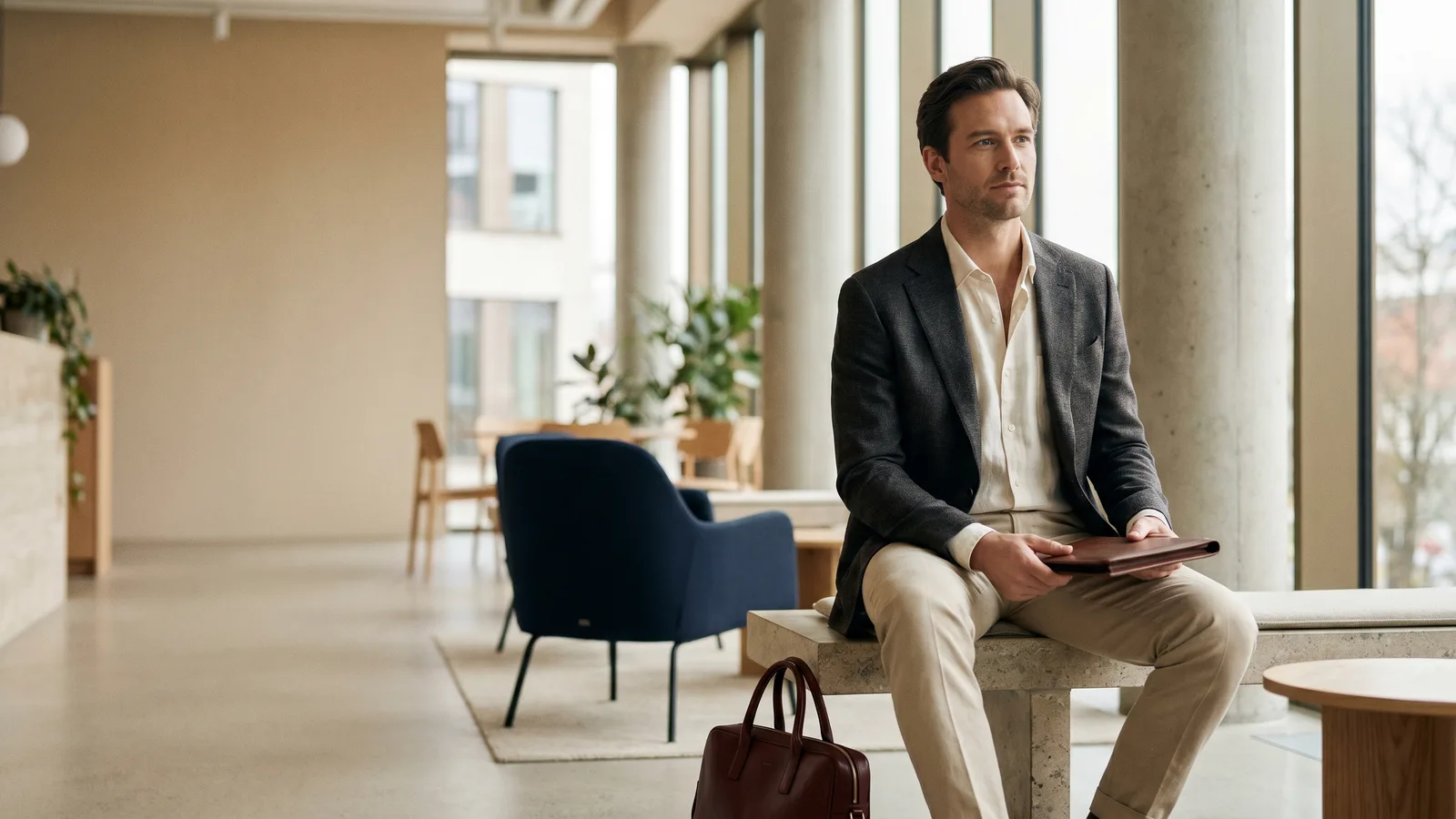
The real question behind “business casual interview dress”
If you searched what to wear to a business casual interview, you’re almost certainly circling the same worry: dress too casually and you look like you don’t care; dress too formally and you look like you misread the room. The job posting or recruiter said “business casual,” and that phrase is doing a lot of work it doesn’t explain. One company’s business casual is a polo and chinos; another’s is a blazer with no tie. You don’t want to be the one who walks in and instantly feels wrong.
The good news: for an interview, the target is narrower and more forgiving than it feels. You are not trying to nail the company’s exact daily uniform. You are trying to look prepared, respectful, and like you put thought into it — which, conveniently, is the one signal that never backfires. This guide walks through how to decode a company’s dress code before you arrive, the safe interview outfit and how to lift it a notch, what changes by industry, the specific pieces that matter, and the adjacent occasions (smart casual events, the business-casual-to-cocktail bridge) that live in the same wardrobe.
How to decode the company’s dress code before you go
Before you choose an outfit, do five minutes of reconnaissance. “Business casual” is a range, and your job is to find where this particular company sits inside it.
- Look at their public photos. Company “about” or “team” pages, recent posts, conference talks — these show what employees actually wear, not what HR wrote in a handbook. A team in polos and sneakers tells you something different than a team in blazers.
- Read the industry, not just the word. Finance, law, and corporate consulting interpret business casual conservatively. Tech, agencies, and startups interpret it loosely. Same two words, very different rooms.
- Ask the recruiter — it’s allowed. “Is there a dress code I should be aware of for the interview?” is a normal, even smart, question. It signals you take the meeting seriously. Recruiters answer it all the time.
- When the signal is mixed, default up. If you genuinely can’t tell, dress to the sharper end. Which leads to the question almost everyone asks.
Is it better to be slightly overdressed for an interview?
Yes — slightly. Showing up a touch sharper than the room reads as respect and effort. Showing up too casual reads as indifference, and that’s the more expensive mistake in a room where someone is deciding whether to trust you. The operative word is slightly: a blazer over a clean business casual outfit, not a three-piece suit at a startup. The goal is to look like the most put-together version of someone who belongs there — not like you wandered in from a different, more formal company.
This is exactly why an interview outfit sits one notch above the company’s daily baseline. You match their floor, then add a single deliberate element you can remove. We cover the mechanics of that in our deeper guide to dressing for a business casual job interview.
The safe business casual interview outfit (and how to dress it up a notch)
Here is the outfit that works in the overwhelming majority of business casual interviews. Treat it as a reliable default you can adjust, not a uniform.
- A collared shirt, pressed. A crisp oxford-cloth button-down or a fine dress shirt in white or light blue. Light blue is quietly flattering and a hair less stiff than white; both are safe.
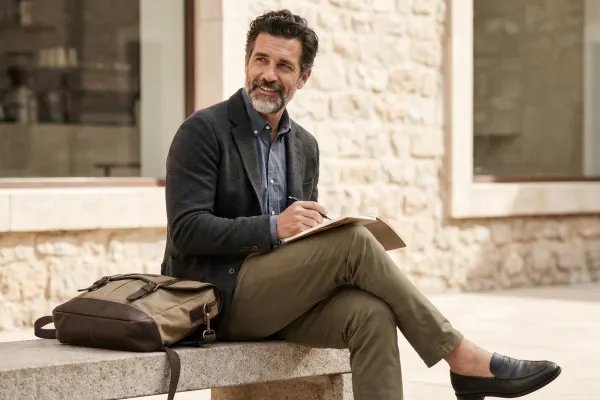
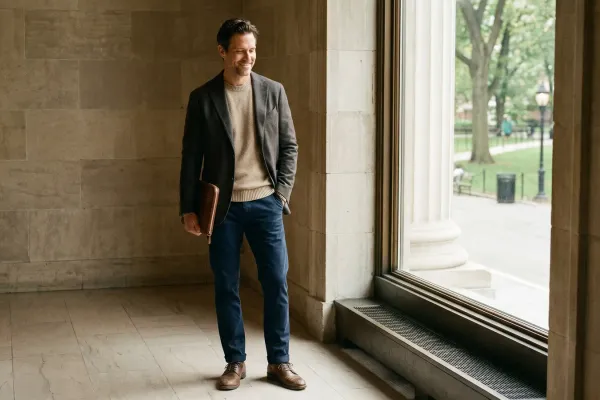
- Tailored trousers. Chinos in navy, gray, stone, or olive, or flat-front wool trousers. They should break cleanly at the shoe with no pooling fabric.
- Clean leather shoes. Derbies, loafers, or chukka boots in brown or black. Polished, not scuffed. Footwear is where interviewers quietly judge.
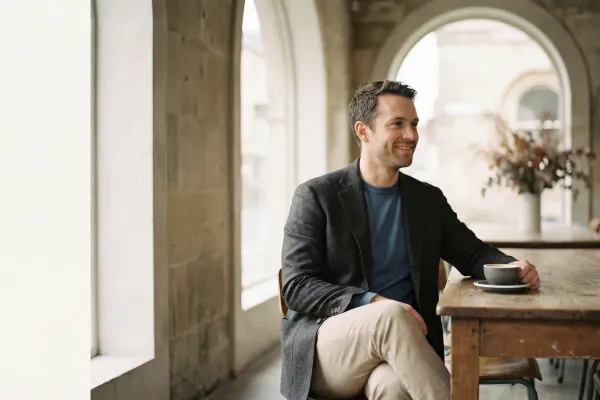
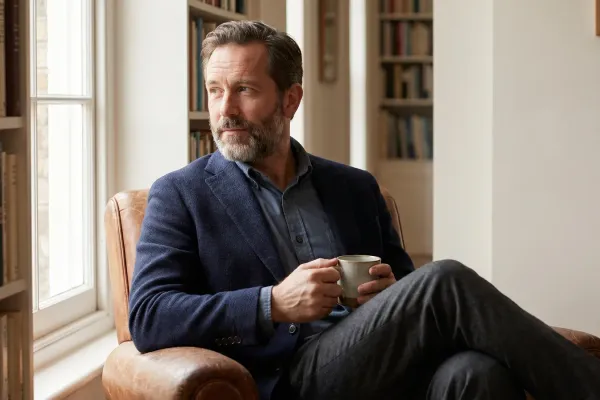
- A blazer or unstructured jacket — this is your “notch up.” An unstructured navy blazer pulls the whole outfit together and signals you dressed for the interview, not just for a Tuesday. It’s the single most effective upgrade.
The “dress it up a notch” move is almost always the jacket. A business casual outfit with a blazer is interview-ready; the same outfit without one is fine-for-the-office but slightly underpowered for a first impression. If a full blazer feels like too much for a relaxed company, a fine merino crewneck or a structured overshirt can do a softer version of the same job. For the foundations of building these outfits, our business casual fundamentals guide covers the core wardrobe this all draws from.
Do you wear a tie — or not?
For a true business casual interview, no tie. A tie nudges the look toward business formal, and at a company that runs casual that can read as trying too hard or misjudging the culture. Let the blazer do the elevating. The exception: if the role is conservative and you couldn’t get a clear read, slip a simple tie into your bag. Adding it takes thirty seconds; you can decide once you see the lobby. Full breakdown of the menswear specifics lives in our business casual interview attire for men guide.
What to wear by industry and formality
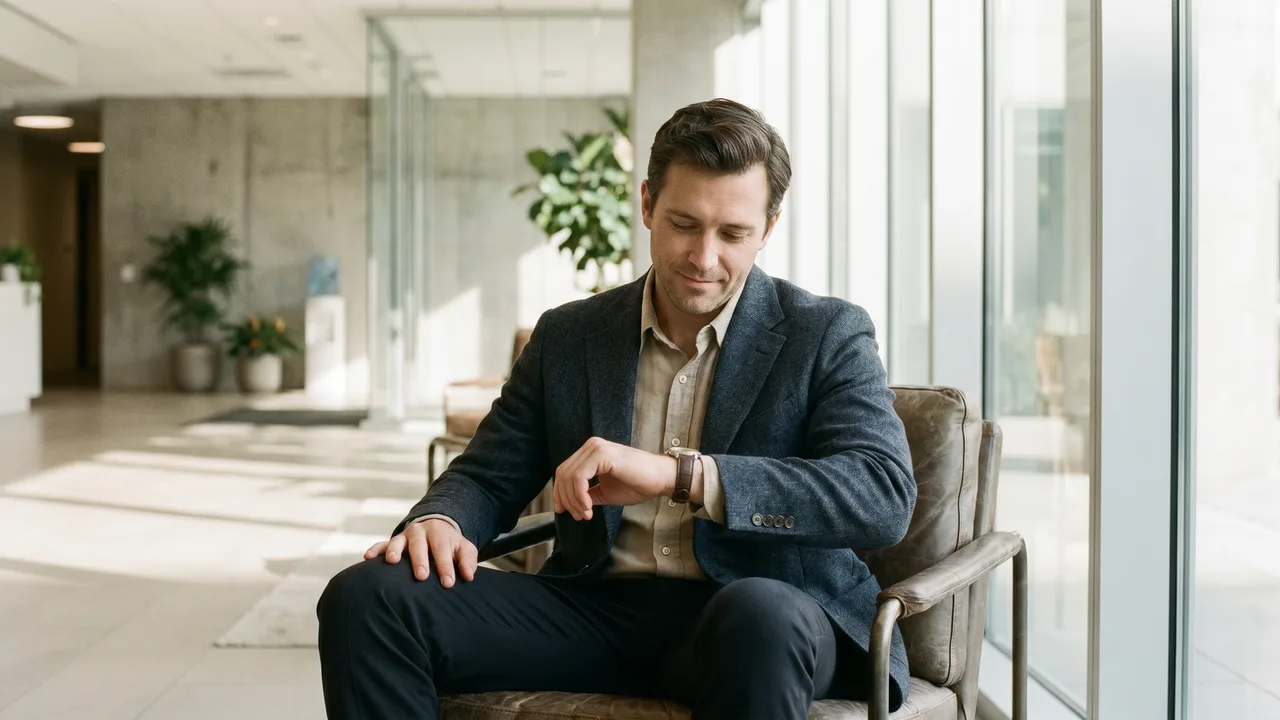
The same two words point to different outfits depending on where you’re interviewing. Find your row.
Conservative industries (finance, law, corporate, consulting)
Dress to the top of business casual, leaning toward business formal. Wool trousers over chinos, a dress shirt over an oxford, a structured blazer, leather oxfords or derbies. A tie is more defensible here than anywhere else — when uncertain, bring one. You will rarely be faulted for looking too professional in these rooms.
Standard professional roles (mid-size companies, B2B, operations, sales)
This is the heartland of the safe outfit above: collared shirt, chinos or trousers, blazer, leather shoes. Clean, considered, not stiff. Our business casual for men: interview edition guide is built around exactly this scenario.
Relaxed and creative companies (tech, agencies, startups, media)
Here you can ease off without dressing down. A fine knit polo or a merino sweater can stand in for the dress shirt; clean minimalist leather sneakers can replace the dress shoes. You’re crossing into smart casual territory — still collared or knit, still intentional, just less formal. If that’s your interview, read our smart casual interview outfits for men guide, which covers where the line sits.
Even at the loosest end, an interview is not the day for the company’s most casual look. Match their floor and add one notch — the principle holds everywhere.
The men’s specifics: shirt, trousers, shoes, layer
A few details separate “fine” from “deliberately put together.”
The shirt. Collar should sit cleanly without gaping. Sleeves end at the wrist bone. Iron it the night before — wrinkles undo an otherwise good outfit and they photograph badly on video calls too. For the full range of shirt choices, our business casual dress shirt guide goes deep on fabrics, collars, and fit.
The trousers. Fit at the waist without a belt fighting them; taper enough to look modern without clinging. Avoid anything shiny, anything with visible athletic stretch seams, and anything that pools at the ankle. Trousers and shoes are covered together in our trousers and shoes guide.
The shoes. Clean and conditioned. Brown leather is friendlier and more versatile than black for business casual; black skews formal. Match your belt to your shoes. Socks should clear your ankle when seated — no skin gap when you cross your legs.
The layer. Navy is the most useful blazer color you can own for interviews; it works against nearly every shirt and trouser. Unstructured (soft shoulder, little padding) reads more business casual than a stiff suit jacket.
Fit and grooming — the part that’s actually decisive
You can own all the right pieces and still look off if nothing fits. Fit beats everything. A modest shirt and trousers that fit well will out-perform expensive clothes that don’t. If your one good blazer is a touch large, a tailor can take it in for less than the cost of dinner, and the difference is visible across a table.
On grooming: tidy hair, trimmed or deliberately maintained facial hair, clean and short nails, and go light on fragrance — interviewers sit close, and an interview is a bad place to be memorable for cologne. None of this is about being handsome; it’s about looking like someone who handles details. Which is the entire subtext of an interview outfit.
What to avoid
The fastest ways to undercut an otherwise solid interview outfit:
- Jeans. Even where denim passes day-to-day, skip it for the interview. Can I wear jeans to a business casual interview? The safe answer is no — default to chinos or wool trousers and remove the question entirely.
- Sneakers that aren’t deliberate. Running shoes, chunky trainers, anything athletic. If you go the sneaker route at a creative company, they must be clean, minimal, and leather.
- Wrinkles and scuffs. The single biggest tell of someone who didn’t prepare. Press the shirt; condition the shoes.
- Logos and loud patterns. Big branding, busy prints, novelty anything. Quiet reads as confident.
- Ill-fitting layers. A blazer that’s too big does more harm than no blazer. If it doesn’t fit, leave it.
- Overdoing the formality at a casual company. A full suit and tie at a relaxed startup is its own kind of misread. Slightly sharper, not several steps removed.
A quick note on video: for a business casual Zoom interview, the same rules apply from the waist up, and they matter more — the camera flattens everything and your collar, shoulders, and grooming fill the frame. Wear real trousers anyway; it changes how you sit and carry yourself, and it saves you if you have to stand.
Adjacent occasions: events, smart casual, and the cocktail bridge
The interview wardrobe overlaps heavily with the rest of a man’s “dressed but not formal” life, so the same pieces stretch further than you’d think.
Smart casual events. Conferences, networking nights, a relaxed off-site — these call for the looser, more expressive version of the interview kit. The blazer can come off; a knit or a textured shirt can lead. The line between business casual and smart casual is subtle, and worth understanding; our smart casual guide maps it out.
The business-casual-to-cocktail bridge. This is where a lot of men get stuck: an invitation says “cocktail attire” or you’re heading from a daytime event to an evening one, and you want to know how far your business casual pieces can carry you. The short version — cocktail leans darker, sharper, and more deliberate than business casual: a darker blazer or a sport coat, a crisper shirt, dressier shoes, and the option of a tie. The bones are the same; the dial turns up. We break down exactly where the two diverge in business casual vs. cocktail attire, which is the piece to read before any evening event.
Understanding this bridge is why building a solid business casual foundation pays off beyond the interview: the navy blazer, the good trousers, the clean leather shoes, and a couple of well-fitting shirts will carry you from a job interview to a wedding-adjacent cocktail event to a conference, with only small adjustments between them.
Putting it together
For a business casual interview, aim one notch above the company’s everyday baseline: a pressed collared shirt, tailored trousers, clean leather shoes, and a blazer you can remove if the room is more relaxed than you expected. Skip the jeans, skip the tie unless the role is conservative, and let fit and grooming do the quiet work. Being slightly overdressed is the right kind of mistake; looking like you didn’t prepare is the costly one.
From there, the same pieces handle the events that share this dress code. When you’re ready to go deeper on any single piece of this — the interview attire breakdown for men, the smart casual interview route, or the cocktail-attire bridge — those guides pick up where this one leaves off.