
When the dress code lands between two worlds
Some invitations are clear. Others put you in a bind — a work event that’s “business casual but festive,” a reception that says cocktail but happens at five in the afternoon, a company party where half the room will read it one way and half the other. You’re left trying to dress for two dress codes at once. This guide is about bridging that gap: building an outfit that reads correctly whether the room turns out to be business casual or cocktail.
These two codes feel far apart, but they share more architecture than you’d think — which is exactly what makes one outfit able to serve both. This sits within the broader occasions and interview dress hub, where related dress-code questions get the same calm, practical treatment.
What each code actually means
Business casual is a daytime, professional register. The backbone is a blazer or sport coat, a collared shirt, and trousers or dark chinos, with leather shoes. No tie required. The palette runs to navy, gray, and stone. It’s the language of the office and the daytime meeting.
Cocktail attire is an evening, social-but-elevated register. The backbone is a dark suit — navy or charcoal — with a crisp shirt and, traditionally, a tie. The palette runs darker. The shoes get dressier. It signals an occasion rather than a workday.
The distance between them is mostly three things: formality, color, and time of day. Cocktail is dressier, darker, and after dark. Business casual is lighter, more relaxed, and during the day. Once you see the gap in those terms, you can engineer an outfit that splits the difference.
The bridge outfit
The move is to build from the cocktail end and soften toward business casual, rather than the reverse — it’s far easier to relax a sharp outfit than to elevate a relaxed one. Here is the bridge:
- A dark suit — navy or charcoal — worn as separates or together. This is the keystone. It reads cocktail when worn whole and business casual when broken up.
- A crisp white or light-blue shirt. Clean enough for cocktail, easy enough for business casual.
- Polished leather shoes — a sleek loafer or a clean oxford in brown or black.
- A tie in your pocket. This is the bridge mechanism. Knotted, the outfit reads cocktail. Off, with the collar open, it reads business casual.
With those pieces, you arrive able to dial the formality up or down by a single adjustment, after you’ve read the room.
Read the room, then adjust
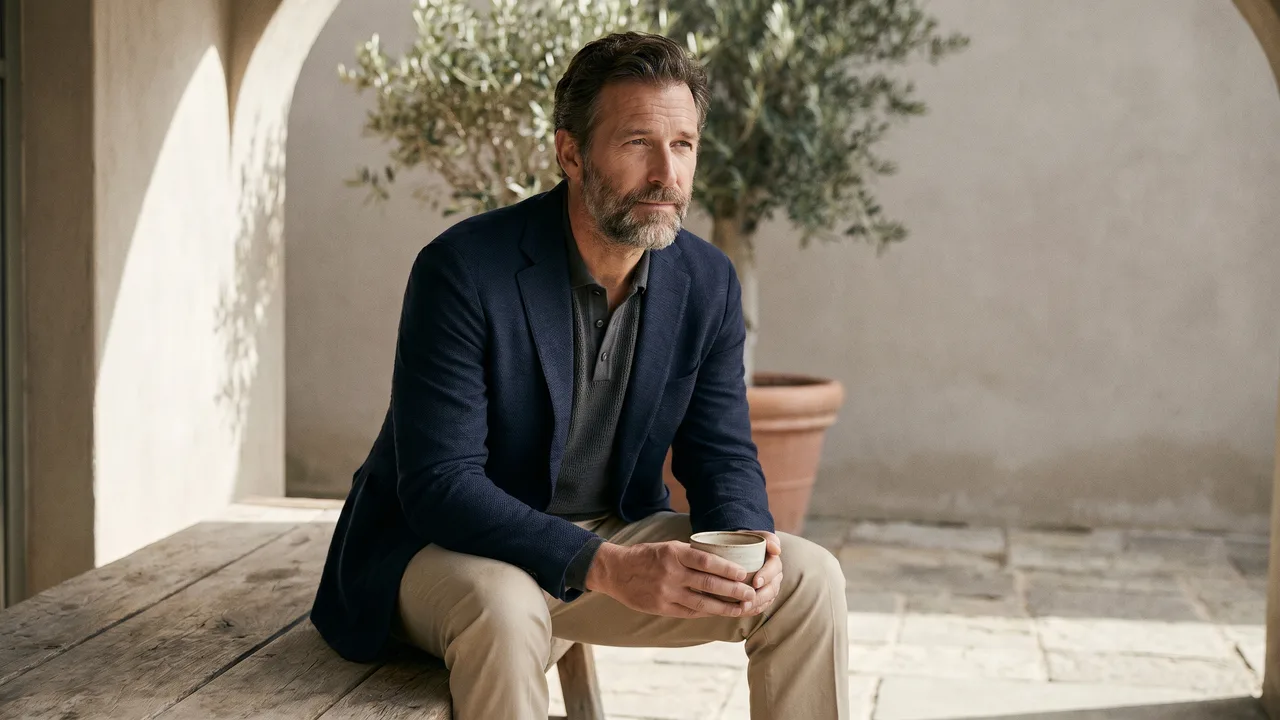
The beauty of the bridge outfit is that you make the final call once you’re actually there.
If the room is dressier than you expected — darker, more ties, evening lighting — knot the tie, button the jacket, and you’ve landed squarely in cocktail. Done.
If the room is more relaxed — daytime light, open collars, a looser crowd — skip the tie, open the top button, and you read as elevated business casual. Also done.
You’ve turned an ambiguous invitation into a non-decision. The outfit holds either way, and you adjust in thirty seconds in the lobby.
Color and time of day do quiet work
Two levers shift the read without changing the clothes:
Color. Darker tones — navy, charcoal, deep gray — pull an outfit toward cocktail. Lighter tones — stone, light gray, tan — pull it toward business casual. If you want to hedge, choose mid-to-dark: a navy that can go either way depending on what you pair with it.
Time of day. The same suit reads more formal after dark and more relaxed in daylight. An evening event tilts everything toward cocktail; an afternoon one tilts toward business casual. Let the timing inform which way you lean before you even arrive.
The pieces to avoid
A few things break the bridge in either direction:
- Anything too casual to be cocktail: chinos in a light color, canvas sneakers, an open-collar polo. These can’t be elevated fast enough if the room turns out dressy.
- Anything too loud to be business casual: a flashy patterned suit, a bold tie, statement shoes. These can’t be relaxed convincingly if the room turns out professional.
- Light or bright colors, which lock you into the business casual read with no path up to cocktail.
Stay in the dark-neutral, sharp-but-quiet lane and the outfit stays flexible.
Three accessories that move the needle
If you want finer control over which way the outfit reads, a handful of small pieces do real work without changing the core clothes.
The tie is the single most powerful lever, which is why it’s the heart of the bridge. On, knotted neatly, it pushes the whole look toward cocktail; off, with an open collar, it relaxes everything toward business casual. Carry one even if you’re unsure — adding it takes thirty seconds and removing it takes less.
The shoes set a quieter tone. A sleek leather oxford or a polished loafer in dark brown or black reads dressier and supports the cocktail end. A more relaxed loafer leans business casual. Whatever you choose, polished and intact is non-negotiable at an evening event.
A pocket square, if you’re comfortable with one, tips an outfit toward cocktail and adds a touch of occasion. Keep it simple — a white linen square folded flat — and skip it entirely if it feels like a stretch. It’s a finishing detail, never a requirement.
Where these events actually come up
The bridge between business casual and cocktail isn’t an abstract exercise — it’s the exact problem behind a long list of real invitations. Company holiday parties, work-adjacent receptions, awards dinners, and networking events that start in daylight and run into the evening all tend to land in this ambiguous zone. So do many weddings with vaguely worded dress codes, and milestone celebrations where the crowd will span a range of formality.
The common thread is that you can’t be certain in advance which way the room will tilt, and you often don’t want to ask. That’s precisely why the dark-suit-plus-tie-in-pocket approach is so useful: it’s a single answer to a whole category of uncertain invitations. Build it once, understand how to dial it up and down, and you stop dreading the next ambiguous line on an invite.
The principle, simplified
When an event lives between business casual and cocktail, dress to the higher of the two and bring one element you can remove to soften it. A dark suit with a tie in your pocket is the cleanest version of that idea: knot it for cocktail, drop it for business casual, and let the room tell you which. The same calm calibration that serves a job interview — read the setting, then adjust a notch — is exactly what bridges these two codes. For the interview version of that logic, the business casual job interview guide and the smart casual interview guide apply the same thinking to a different occasion.