
What actually makes a shirt “business casual”
If you have ever stood in front of your closet wondering whether a shirt is too formal for the office or not formal enough, you are asking the right question — and you are far from alone. The most common version online is blunt: “I want to wear nicer, more dress-clothes-style shirts, but I don’t want to look like I’m going to a wedding.” That gap, between looking like you tried and looking like you are overdressed, is exactly what business casual is meant to fill.
A business casual dress shirt is a shirt that can hold its own without a tie, without a suit, and without a jacket — yet still looks intentional. It is the single most versatile thing in a man’s wardrobe, because the same garment can read sharp under a blazer or relaxed with the sleeves rolled. Getting it right is less about owning expensive shirts and more about understanding a handful of variables: fit, fabric, collar, color, and how you wear it.
This guide covers all of it. By the end you will know how to pick a shirt that works, how to wear it so it looks deliberate rather than accidental, and which mistakes quietly undo an otherwise good outfit. For the broader picture of how shirts fit into a complete look, see our business casual fundamentals guide.
One thing worth saying up front: there is no single shirt labeled “business casual.” The category is defined by where it sits on a sliding scale between a tuxedo shirt and a t-shirt. Most of the choices below are about nudging a shirt up or down that scale on purpose, rather than landing somewhere by accident. Once you can see the dials, you can dress for almost any room.
Fit comes first — everything else is secondary
You can own the finest shirt in the world and it will look cheap if it fits badly. Fit is the difference between a shirt that flatters and one that looks borrowed. Here is what to check, top to bottom.
The collar
Button the top button and slide two fingers inside the collar. If they fit with a little room, the collar is right. If it chokes, size up; if you can fit your whole hand, it is too loose and will gap and slump all day. A common frustration is the opposite — “is there anything that can be done to dress shirts that are too tight at the collar?” — and the honest answer is that a collar a half-size too small is rarely worth saving. Buy to the neck and have the body taken in if needed.
The shoulders
The shoulder seam should sit right where your shoulder ends and your arm begins. This is the hardest thing for a tailor to fix, so it is the one measurement you should get right off the rack. If the seam droops down your upper arm, the shirt is too big — and no amount of tucking will hide it.
Sleeves and cuffs
The cuff should end at the base of your thumb, so a thin sliver of shirt shows past a jacket sleeve. When you reach forward, the cuff should not ride halfway up your forearm. A cuff that fits also makes rolling the sleeves look clean rather than bunched.
The body
You want a trace of shape through the torso — close enough that there is no billowing sail of fabric when you tuck in, loose enough that you can sit, reach, and breathe. The pull-test: if buttons strain across the chest or stomach, it is too tight. If you can pinch four inches of fabric at your side, it is too big. Plenty of men ask how to wear dress shirts that are too big without looking like they’re drowning — the real fix is usually a tailor and about fifteen dollars.
The length
Length determines whether you can wear the shirt untucked, which we will return to below. For now: a proper dress shirt has a long, curved tail meant to stay tucked. A shirt built to be worn out is cut shorter and straighter at the hem.
Fabric and weave: where formality really lives
Two shirts in the same color can sit at opposite ends of the formality scale purely because of how the cloth is woven. This is the lever most men never think about, and it is the one that does the most work.
- Oxford cloth. A slightly basket-woven, textured cotton with a touch of heft. It is the workhorse of business casual — relaxed enough to wear untucked with chinos, sharp enough under a blazer. If you buy one shirt, make it an oxford. The classic oxford-cloth button-down is arguably the most useful shirt a man can own.
- Poplin (broadcloth). Smooth, fine, and lightweight with a subtle sheen. This is the most formal everyday weave — crisp and clean, but it reads dressier, which makes it perfect under a jacket and slightly stiff worn fully casual.
- Twill. A diagonal weave that is durable, drapes well, and resists wrinkles better than poplin. A reliable middle ground.
- Chambray. Lightweight and softly textured, often with a faded denim-like look. Inherently casual and excellent for an open-collar, no-jacket day.
- Linen. The summer answer. Breathable and elegantly rumpled — it is supposed to wrinkle, so do not fight it. The recurring warm-weather question of “how do men in suits and dress shirts survive summer?” usually ends at linen and lightweight cotton.
- Flannel. Brushed and warm, leaning rugged. A flannel in a muted check can absolutely work for business casual in cold months, worn as a layer.
Collar types and why they matter without a tie
The collar is the frame for your face, and in a no-tie world it carries more visual weight than anything else on the shirt. The two you will use most:
- Point collar. Narrower spread between the points; classic and slightly more formal. Works with or without a tie.
- Spread / semi-spread collar. Wider angle between the points. Versatile and modern; pairs well with a jacket.
- Button-down collar. The points fasten to the shirt with small buttons. The most casual and the most foolproof for an open collar, because the buttons keep the points anchored instead of flopping.
Here is the detail that separates a deliberate open collar from a sloppy one. With no tie holding things together, an unsupported collar tends to slump and splay — the points wander, the collar collapses, and the whole look goes limp. A collar with real structure, whether a button-down or one with proper interlining, stands up and frames the neck on its own. This is the single biggest reason an open-collar shirt looks either intentional or careless. We go deep on keeping the collar crisp in the collared-shirt and collar-stays guide, and on the open-collar look specifically in the no-tie guide.
Color and pattern: build from a small, strong base
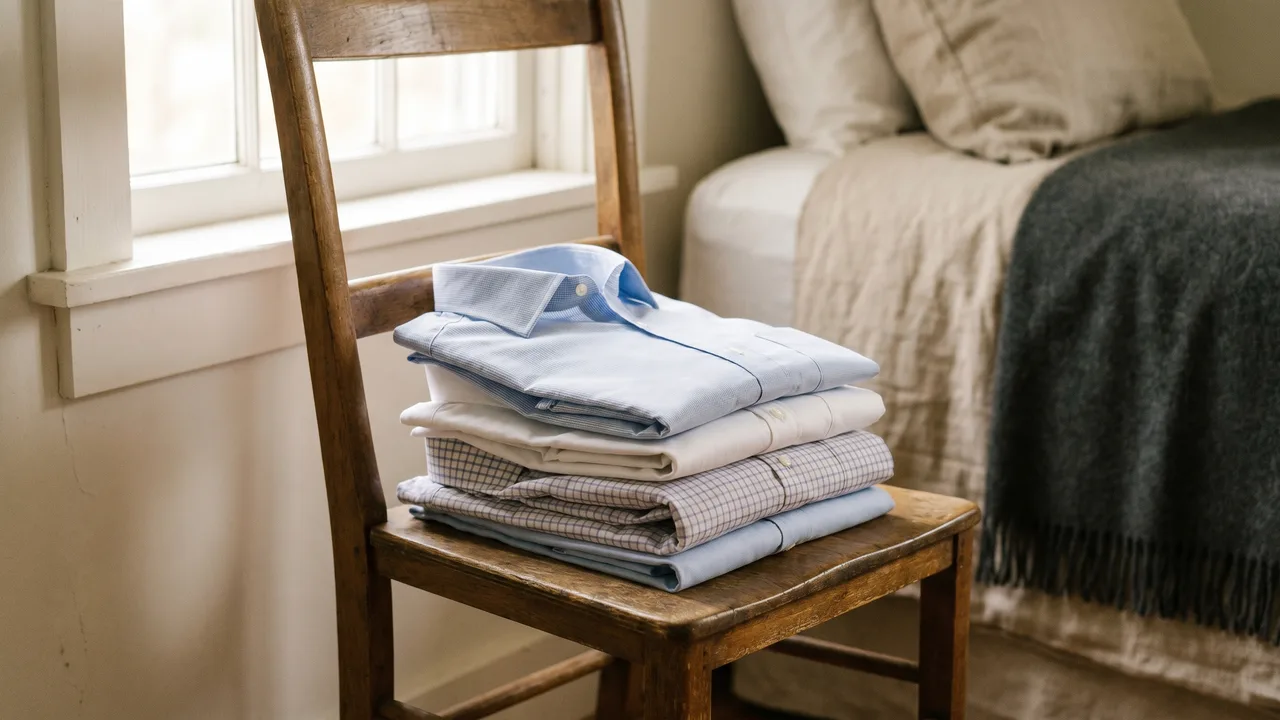
You do not need a rainbow. A handful of well-chosen colors will outfit you for months.
- Light blue is the most useful shirt color in menswear. It flatters almost every complexion, looks less stark than white, and quietly hides a long day better.
- White is the sharpest and most formal. Essential, but on its own it can read slightly severe for casual settings — which is why a crisp white casual dress shirt pairs so well with relaxed trousers to soften it.
- Soft neutrals — light gray, pale pink, sand — extend the palette without shouting.
For patterns, stay subtle. A fine stripe (university, bengal, or pencil) and a small check (gingham, tattersall) are the safest steps beyond solids. The rule of thumb: the smaller and more muted the pattern, the more versatile and professional it stays. Bold, large-scale prints pull a shirt out of business casual fast.
Sleeve length: long versus short
Long sleeves are the default and the more versatile choice — they can be worn down and buttoned, or rolled for a relaxed feel. For most offices, long-sleeve casual dress shirts should be the core of your rotation; rolling the cuffs is the easiest way to take a shirt from desk to dinner.
Short sleeves are trickier. A cheap short-sleeve button-up can look like a uniform shirt, but a well-cut one in a good fabric is a genuinely smart warm-weather option. The keys are a trim sleeve that ends mid-bicep (not flapping at the elbow) and a quality cloth. We cover how to do it without looking frumpy in the guide to short-sleeve casual dress shirts done right.
Tucked or untucked — let the shirt decide
This is one of the most-debated questions men ask, and the answer is not a matter of taste so much as construction. Look at the hem:
- A long, curved shirttail that drops several inches below your waistband was designed to be tucked. Worn out, it hangs past your fly like a dress and looks unkempt.
- A shorter, straighter hem that lands around the middle of your fly was built to be worn untucked.
For most office settings, when in doubt, tuck — it always reads more put-together. But a properly cut untucked shirt over chinos is a legitimate, polished business casual look, not a compromise. The mistake is forcing a long formal shirt to be worn out.
How to wear it: making a dress shirt read casual
The same shirt can swing formal or relaxed depending entirely on how you wear it. To dress one down:
- Lose the tie and open the collar — one button undone.
- Roll the sleeves to just below the elbow for a deliberate, unfussy forearm.
- Change the trousers. Chinos or dark, clean denim instantly recalibrate a shirt from boardroom to weekday casual.
- Layer it. A shirt under a fine-gauge crewneck or a casual jacket reads relaxed and considered at once.
This is also where the polo and even the t-shirt enter the conversation. A polo can be solidly business casual in the right fabric and fit, and on the most relaxed end, there are settings where a t-shirt can pass as business casual — under a blazer, in a quality heavyweight, with the right trousers.
Care: keep the shirt looking like you mean it
A great shirt worn badly cared-for looks worse than a cheap one kept crisp.
- Wash inside out in cold water and skip overloading the machine.
- Hang or pull from the dryer slightly damp and let it finish on a hanger to cut down on wrinkles, or press while lightly damp.
- Wash buttoned or unbuttoned? Either is fine; buttoning the collar can help it keep its shape, but it is not essential.
- Mind the collar stays. Plastic collar stiffeners should be removed before washing — leaving them in can warp them or damage the collar. Many shirts ship with removable ones for exactly this reason; metal stays last far longer and hold a crisper line.
- Store on good hangers, not wire, so the shoulders keep their shape.
Common mistakes that undo a good shirt
- A gaping or slumping collar. The fastest way to look sloppy without a tie. Structure fixes it.
- Wearing a too-big shirt. Billowing fabric at the waist and drooping shoulders read as careless. Tailor it.
- Too many buttons open. One is right; two is the ceiling; three looks like a night out.
- Forcing a formal shirt to be worn untucked. Long curved tails belong tucked in.
- Loud patterns or shiny “going-out” fabrics. They pull the shirt out of business casual entirely.
- Letting white do all the work. It is sharp but stark; light blue and texture make an outfit look considered rather than uniform.
Get the fit right, choose fabric and collar with intent, keep the palette tight, and care for the shirt — and you have the foundation of a business casual wardrobe that looks effortless because it actually is. From here, dig into the specific guides below for the parts that matter most to how you dress.