Build the outfit from the pieces up
If you’ve been told an interview is business casual and you want a concrete answer to what do I actually put on, this is the piece-by-piece breakdown. Rather than describing a vibe, we’ll name each component, explain what it does, and give you the safe default plus one or two acceptable swaps. Assemble them and you have an outfit that works for nearly any business casual interview, in nearly any industry.
For how to think about interview dressing as a whole — the underlying principle and the edge cases — start with the interview dress hub. This page is the parts list.
The five pieces
A complete business casual interview outfit is five things. Everything else is optional.
- A blazer or sport coat
- A collared shirt or fine knit
- Dressy trousers or dark chinos
- Leather shoes
- A matching leather belt
Get those five right and you are done. Notice what’s not on the list: a tie, a pocket square, a watch, a particular brand. Those are details you can add or skip, and an interviewer will never penalize their absence. The five core pieces, fitted and clean, are the entire outfit — which is good news, because it means the assignment is finite and you can buy or borrow your way to a complete one without guesswork. Let’s take them one at a time.
1. The blazer
The blazer is the piece that does the lifting. It’s the difference between “a guy in nice clothes” and “a guy who came to interview.” It structures your silhouette, frames your face, and signals effort instantly.
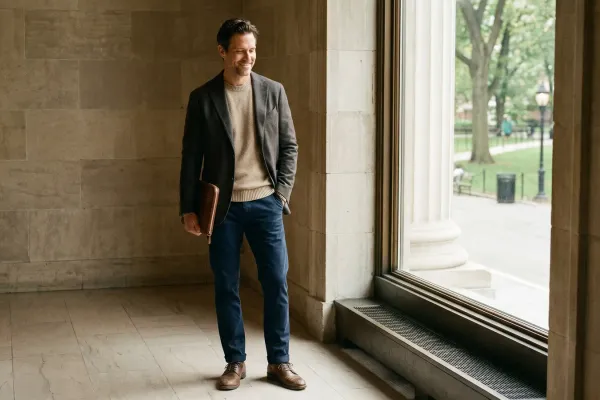
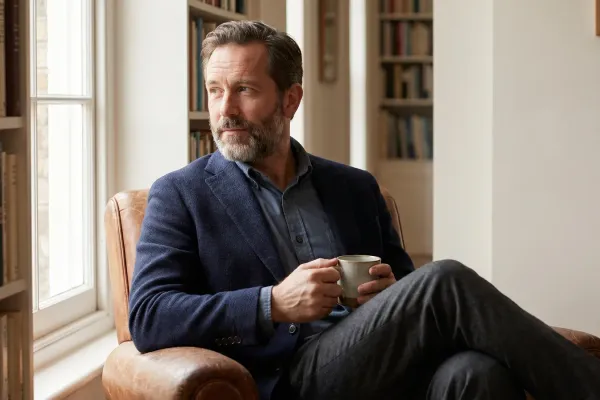
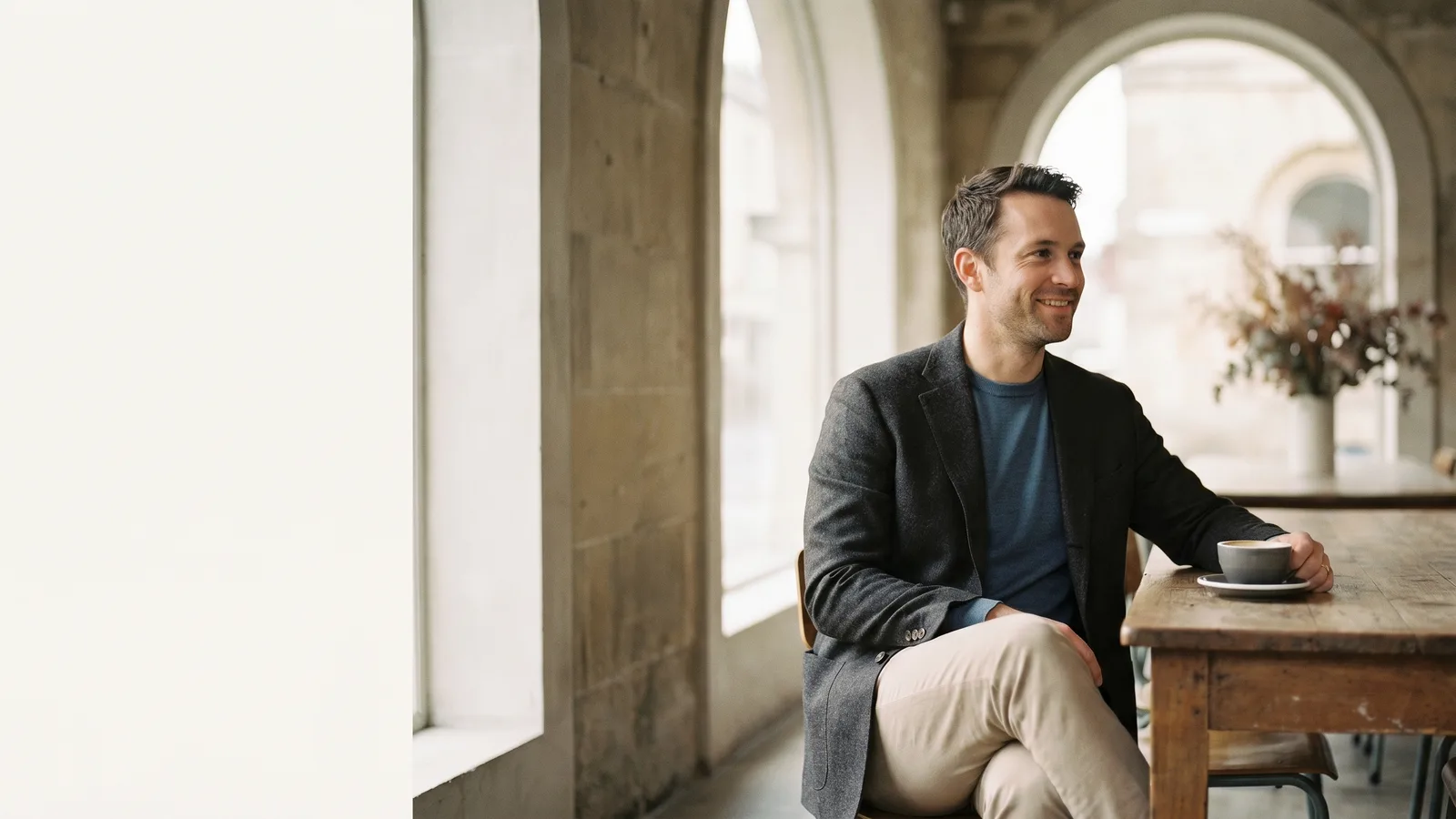
Default: an unstructured navy blazer. Navy flatters everyone, pairs with every trouser color, and never looks like you’re wearing half a suit.
Swap: charcoal, or a textured neutral like a muted gray check if you already own one and it fits well.
Fit notes: the shoulder seam should sit at the edge of your shoulder, not past it. When buttoned, the lapels should lie flat with no X-shaped pulling. The sleeve should end where your wrist meets your hand, showing a half-inch of shirt cuff.
If you don’t own a blazer, a fine-gauge merino crewneck over a collared shirt is the credible fallback. It still reads deliberate. The smart casual interview guide leans into that knit-forward look in more detail.
2. The shirt
Default: a crisp, solid collared shirt in white or light blue. These two colors never compete with your face, photograph cleanly, and pair with any blazer.
Swap: a quiet micro-stripe or a very subtle check, if you’d rather not wear a plain shirt. Keep the pattern small enough that it reads as solid from across a table.
Fit notes: the collar should close comfortably with room for one finger. The body should follow your torso without billowing. Press it the night before — a wrinkled shirt undoes a good blazer.
3. The trousers
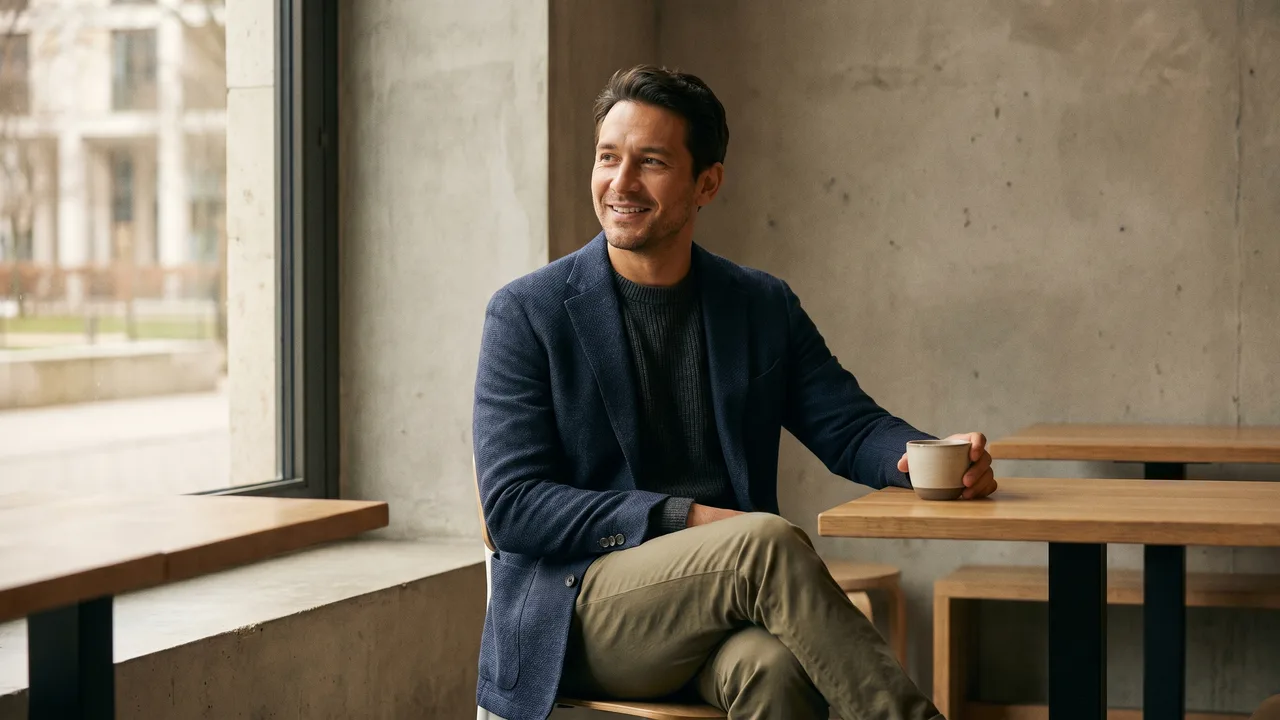
Default: dark chinos in navy, charcoal, or stone. Clean, versatile, and quietly correct.
Swap: flat-front wool trousers if you want to lean more formal, especially for finance, law, or a client-facing role.
Fit notes: sit them at your natural waist so they stay put without a tight belt. Taper enough that there’s no pooling at the ankle, and hem them to a slight break on the shoe. Never wear jeans to the interview, even at a jeans-friendly company.
4. The shoes
Footwear is where men most often give away an otherwise sharp outfit. Leather, polished, intact.
Default: a brown leather derby or loafer. Brown pairs naturally with navy and gray.
Swap: a clean, minimalist leather sneaker for a creative or tech setting; black leather if your trousers are charcoal and the role leans formal.
Avoid: canvas, running shoes, anything scuffed or with a chunky athletic sole.
5. The belt
Small piece, easy win: match the belt to the shoes. Brown shoes, brown belt. Black shoes, black belt. Mismatched leathers are one of the few details an interviewer might actually clock.
Three outfits you can copy
If you’d rather not assemble from scratch, here are three complete formulas:
The safe default (works almost anywhere): Navy blazer, white shirt, charcoal trousers, brown derbies, brown belt.
The slightly creative (tech, design, media): Fine gray merino crewneck over a light-blue collared shirt, stone chinos, clean leather sneakers.
The lean-formal (finance, law, consulting): Charcoal blazer, light-blue shirt, navy wool trousers, black loafers, black belt — add a tie if you want the extra notch.
Color is simpler than it looks
You only need to remember three pairings. Navy goes with gray, stone, and white. Gray goes with navy, white, and light blue. Brown leather goes with navy and gray; black leather goes with charcoal. Stay inside those lanes and nothing will clash.
Building a small interview kit you can reuse
If you have more than one interview coming, or you simply want to stop reassembling an outfit from scratch each time, think in terms of a compact interview kit. A handful of versatile pieces, chosen to mix, will dress you for almost any business casual interview for years.
The foundation is one navy blazer, two shirts (white and light blue), one pair of dark chinos, one pair of wool trousers, and one pair of brown leather shoes with a matching belt. That’s it. Those pieces recombine into several complete, correct outfits without a single weak link. Because everything is neutral and everything coordinates, you can’t make a wrong choice among them on a stressful morning.
Buy the best fit you can rather than the most pieces. One blazer that fits beautifully beats three that fit acceptably. If the budget is tight, prioritize in this order: get the trousers and shirt right first because they touch the most of your body, then the shoes because they’re the hardest to fake, then the blazer. A modest kit chosen for fit will out-dress a large wardrobe chosen for variety every time.
The fit details that separate good from sharp
Two men can wear the identical five pieces and look entirely different, and the difference is almost always fit. A few specifics are worth checking in a mirror before you commit to an outfit.
The blazer should button without strain and the lapels should lie flat against your chest — any X-shaped pulling around the button means it’s too tight. The shoulder seam should land right at the bone, not droop onto your arm. Shirt sleeves should end at the wrist; blazer sleeves should stop about half an inch shorter so a sliver of cuff shows. Trousers should sit at the waist without a belt straining to hold them, and the hem should just touch the top of the shoe with at most a slight break. None of this requires expensive clothes — it requires clothes that fit, which a tailor can deliver on inexpensive pieces for very little. That single trip is the highest-return move in this entire guide.
The optional extras
A watch, a pocket square, a quiet pattern in the shirt — these are detail, not foundation. They can add polish if they’re understated, but no interviewer has ever held the absence of a pocket square against a candidate. Get the five core pieces right first. Everything after that is fine-tuning.
When the outfit is built, the only thing left is to confirm it fits the specific company — and the interview edition for men covers how to calibrate these same pieces to a particular industry.