
Same two words, very different rooms
“Business casual” is one phrase that describes a dozen different rooms. A business casual interview at a corporate bank and a business casual interview at a six-person design studio call for genuinely different outfits — and the men who get tripped up are usually the ones who treated the phrase as a fixed formula instead of a starting point that needs calibrating to the company in front of them.
This guide is about that calibration. The mechanics of the outfit — the blazer, the shirt, the shoes — are covered in the interview attire breakdown and in the broader interview dress hub. Here, we focus on the harder skill: reading the specific workplace and dialing your look to match it.
The one rule that travels across every industry
Before the industry-by-industry detail, internalize the principle that holds everywhere: find out how the company dresses, then dress one notch above it for the interview.
This is the only rule you truly need. It adapts automatically to context. At a suit-and-tie firm, one notch above the daily norm is a sharp suit. At a tech company in hoodies, one notch above is a blazer over a collared shirt. You are always reading the room and stepping up a single, deliberate level — enough to show you took the meeting seriously, not so much that you look like you misread the place.
How to actually read the company
You usually have more signal than you think. Before the interview:
- Look at the company’s website — team and culture pages often show how people dress.
- Check LinkedIn photos of the team and the person interviewing you.
- Search for office photos or recent event posts.
- Just ask the recruiter. “What’s the dress code for the interview?” is a normal, sensible question that signals you care about fit. It’s the most reliable source of all.
Whatever you learn becomes your baseline. Then you add the notch.
It’s worth saying that asking the recruiter is not a sign of uncertainty — it reads as the opposite. A candidate who confirms the dress code comes across as someone who pays attention to detail and wants to get things right, which is exactly the impression you’re trying to make. Recruiters field this question constantly and answer it without a second thought. You lose nothing by asking and remove all the guesswork in one short email.
Calibrating to the field
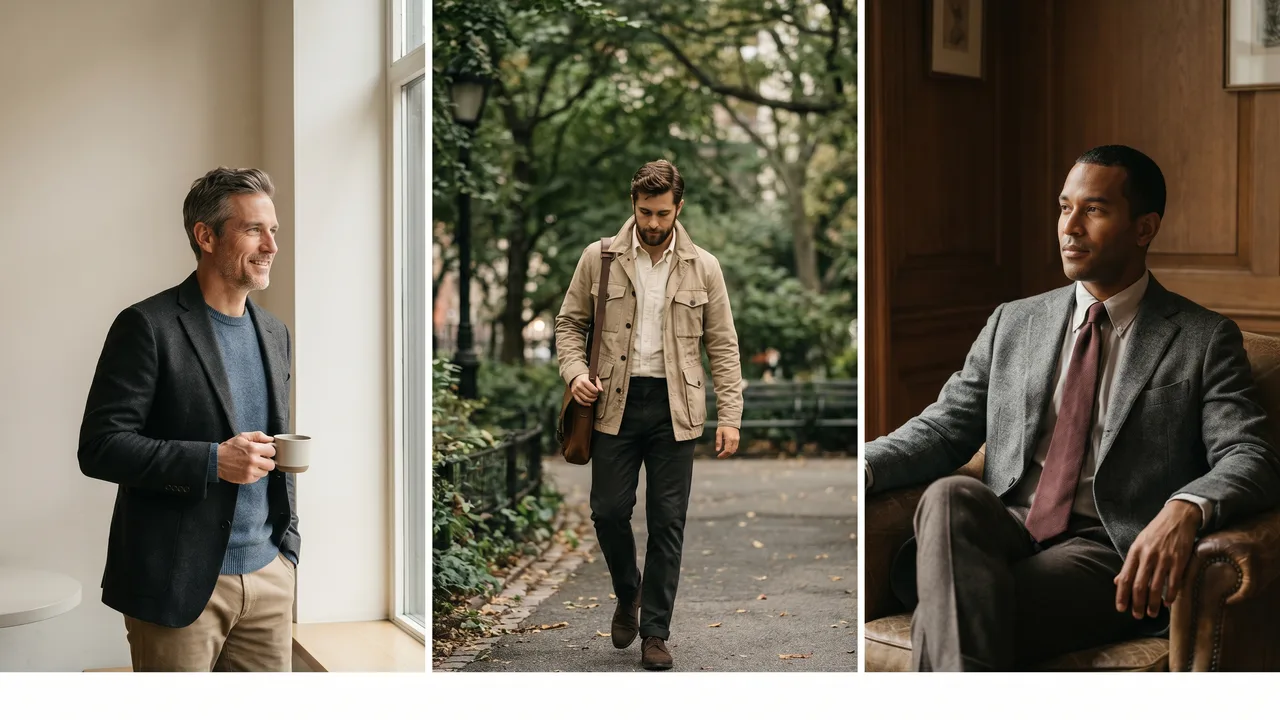
Finance, law, consulting, accounting. These rooms lean formal even when the words say “business casual.” Treat business casual here as the floor, not the target. A blazer is mandatory; a suit is rarely wrong. Stick to navy and charcoal, white or light-blue shirts, leather shoes. A tie is a safe choice and often expected for a first-round interview. Quiet and conservative wins.
Corporate and mid-size companies (operations, HR, sales, marketing). This is the heartland of true business casual. A navy blazer, collared shirt, dark chinos or wool trousers, and leather shoes is exactly right. A tie is optional. This is the most forgiving environment, and the default outfit serves it perfectly.
Tech and startups. The daily norm is genuinely casual — tees, hoodies, sneakers. One notch above that is a blazer (or a fine knit) over a clean collared shirt with good chinos and leather sneakers or loafers. A full suit can read as slightly out of step here, though it’s never disrespectful. Aim for “sharp but relaxed.”
Creative, design, media, agencies. Personality is permitted, even welcomed — but at the interview, keep it disciplined. A well-fitting blazer in a textured neutral, a knit, considered footwear. You can show a point of view through fit and quality rather than loud color or pattern. Polish still matters; it just wears a slightly looser collar.
”Match the vibe” is a trap
A lot of advice tells men to “match the company’s vibe.” Be careful with that. If you match a casual company’s daily vibe exactly, you’ve dressed for an ordinary Tuesday — not for the meeting that decides whether you get hired. Match their level of polish and then step up a notch. You want to look like someone who would clearly belong there once hired, while making it obvious you treated the interview as an occasion. That gap — fitting in, plus visible effort — is exactly what you’re going for.
You can almost never overdress
The fear of overdressing is one of the most common and least justified worries men bring to interviews. A suit at a casual startup might feel a touch stiff, but it never reads as disrespectful, and it’s trivially easy to soften — lose the tie, open the collar, leave the jacket on the chair. Underdressing has no such escape hatch. When you can’t decide, lean formal. You can always dress down in the room; you can’t dress up once you’re sitting there.
The video interview is its own room
A growing share of first-round interviews happen on camera, and a webcam changes the calibration in small but real ways. The screen flattens everything: it compresses color, loses the texture of your clothes, and frames you from roughly the chest up. That means the top half of your outfit carries the entire impression, and a few choices that don’t matter in person suddenly do.
Wear solid, mid-tone colors. A clean navy or mid-blue collared shirt or a fine solid knit reads sharply through a webcam, while tight patterns — small checks, fine herringbone, dense stripes — can shimmer and distract on screen. Avoid pure white right against a bright background, which can blow out and pull the camera’s exposure off your face. Dress the bottom half too, even though it’s out of frame: it keeps your posture honest and saves you if you have to stand. And calibrate the same way you would in person — read how the company dresses and step up a notch. A video setting doesn’t lower the bar; it just narrows where the attention lands.
Common calibration mistakes
A few predictable errors account for most of the misfires men make reading a company:
- Treating “business casual” as one fixed outfit. It isn’t. The same words mean a suit at a bank and a blazer-over-knit at a startup. Always re-read it against the specific field.
- Matching the daily vibe instead of stepping above it. Showing up dressed for an ordinary workday at a casual company means you skipped the notch. Add it.
- Under-researching the company. The signal is usually there — websites, LinkedIn, a quick question to the recruiter. Guessing blind is the avoidable error.
- Fearing overdressing more than underdressing. The math runs the other way. Lean up when unsure.
Avoid those four and your read will be right far more often than not, across any industry you walk into.
After you’re hired, the calibration flips
Everything above is about the interview. Once you have the offer, the goal inverts: now you want to fit the daily norm, not exceed it. Your first week is about reading the actual room and settling into it — losing the notch you added, keeping the fit and the quality. If you’re weighing a “smart casual” instruction specifically, the smart casual interview guide covers how that particular cue changes the math. For the interview itself, the principle is settled: read the company, then dress one notch above it.