What “business casual” actually means below the waist
Most of the confusion about business casual lives in the lower half. Men generally get the shirt right and then stall on the obvious questions: Are jeans allowed? What shoes count? Can I wear sneakers? What color pants do I even buy? Those are the searches people actually type, and they are the right ones to ask, because trousers and shoes are what move an outfit between “I made an effort” and “I rolled out of bed.”
The good news is that the lower half is more rule-bound and therefore easier than the top. There is a short list of trousers that work, a short list of shoes that work, and a handful of mistakes that quietly undercut everything else you put on. This guide covers the whole thing head to toe from the waist down: what to wear, why it works, and where the lines actually fall. For the broader philosophy of the dress code, start with the business casual fundamentals; this page is the bottoms-and-footwear half of that picture.
Trousers: the four that carry the dress code
Business casual trousers are defined as much by what they are not as by what they are. They are not suit trousers, and they are not athletic or technical pants. They sit in the middle: structured enough to look intentional, relaxed enough to wear without a jacket. Four categories cover nearly every situation.
Chinos: the backbone
If you buy one pair of trousers for business casual, buy chinos. They are the unofficial uniform of the dress code for good reason: cotton twill, a clean flat front, no pleats needed, and a finish that reads as smart without tipping into formal. They dress up with a button-down and leather shoes and dress down with a polo and clean sneakers, which is exactly the range business casual asks for.
Start with tan or stone, then add navy and a mid-gray. Those three colors handle the overwhelming majority of outfits. Avoid cargo pockets, drawstrings, and heavy washes or distressing, all of which pull a chino toward weekend territory. Because chinos do so much of the work here, they get their own deep dive in chinos for business casual, which covers fit, color, and styling in detail.
Dress trousers
A notch dressier than chinos, dress trousers are made from finer wool or wool-blend fabrics with a smoother drape and a cleaner crease. They are the right call for client-facing days, more traditional offices, or any time you want to look like the most put-together person in the room without wearing a full suit. Charcoal and navy are the workhorses. Mid-gray is a strong third. These are the trousers that bridge business casual and business formal, so they earn their keep if your week swings between the two.
Khakis and other cotton trousers
“Khaki” technically refers to a color, but in practice most men use it to mean tan cotton trousers, which overlap heavily with chinos. The distinction barely matters in a closet. What matters is keeping them clean-lined and well-fitted. Khaki pants are a business casual staple precisely because they are unobjectionable: neutral, familiar, and easy to pair. Linen and linen-blend trousers extend the same idea into hot weather; they wrinkle by design, so wear them in summer and own the relaxed look rather than fighting it.
The jeans question
This is the one everyone wants answered, and the honest answer is: it depends on your office, and most jeans don’t qualify. The denim that can read as business casual is dark, solid indigo or black, with no fading, no rips, no distressing, and a clean straight or slim cut. Worn with a tucked shirt and leather shoes, that kind of dark denim passes in many relaxed and creative workplaces. Light washes, faded knees, bootcut, and anything distressed do not.
In more traditional offices, jeans of any kind are simply outside the dress code, and the safe move is chinos. Because this question has so many wrinkles, we cover it from two angles: the general ruling in can you wear jeans for business casual, and the specific case of indigo denim in blue jeans in business casual. If you take one thing from here: when you’re unsure, chinos remove the risk entirely.
Fit and break: the part that does the heavy lifting
Color and fabric matter less than fit. A perfectly chosen trouser in the wrong size looks careless; an ordinary trouser that fits well looks deliberate. Aim for a clean line through the seat and thigh, neither sprayed-on nor billowing. The waist should sit without a belt straining to hold it up.
“Break” is how the hem meets the shoe. For business casual, a no break or slight break is the modern, clean look: the trouser just kisses the top of the shoe or breaks once, lightly. Too much break, where fabric pools and stacks over the shoe, makes even good trousers look sloppy. If your pants are pooling at the ankle, a tailor can hem them in minutes, and it’s the single cheapest upgrade you can make to the whole lower half.
Color and break, in practice
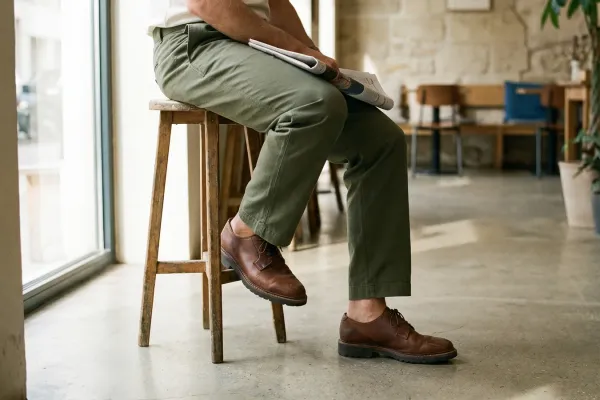
Trouser color quietly sets the register of an outfit before anyone notices the shirt or shoes. Navy and charcoal read dressiest and most authoritative; they’re the colors to reach for when you want to look like the most pulled-together person in the room. Mid-gray is the easy everyday neutral that pairs with almost any shirt. Stone and tan are softer and more relaxed, perfect for ordinary office days. Olive is the low-risk way to step beyond neutrals; it behaves like a neutral but adds a little character, and it pairs especially well with brown and suede shoes. A quick rule: when in doubt, the darker the trouser, the dressier the read.
Break works the same way, only with the hem. A no break shows a sliver of ankle or sock and reads as clean and modern; a slight break, where the hem just touches the shoe and creases once, is the safe classic. Both look intentional. The failure mode is full break, where fabric stacks and pools over the shoe, which makes even an expensive trouser look borrowed. The rule is short: aim for no break or slight break, and if your trousers are pooling, get them hemmed.
Fabric and season
You don’t need two wardrobes for two seasons; you need the right fabrics in your rotation. Cotton (chinos, khakis) is the all-rounder that works most of the year. Wool and wool blends (dress trousers) breathe better than people expect and drape cleanly, comfortable across cool and temperate months. Linen and linen blends are the warm-weather answer: built to wrinkle, so wear them in summer and let the relaxed texture be the point.
Shoes flex the same way. Suede loafers and lighter leather read cooler for spring and summer; a clean leather boot or a darker derby grounds an outfit in fall and winter. The single most adaptable combination across the year is a neutral chino with a brown derby or loafer, which is why chinos carry so much of the dress code.
Footwear: the business-casual shoe hierarchy
Shoes are where the dress code is most visible and most often gotten wrong. The principle is simple: business casual footwear is leather (or suede), it is closed, and it is neither a formal dress shoe nor an athletic shoe. Within that band, there’s a clear hierarchy from dressiest to most relaxed.
Oxfords and derbies
Oxfords (closed lacing) are the dressiest of the everyday options and lean slightly formal; derbies (open lacing) are marginally more relaxed and, for that reason, the more natural business-casual choice. A medium-to-dark brown derby is arguably the most useful shoe a man can own for this dress code. It pairs with khaki, navy, and gray, dresses a chino up instantly, and never looks out of place. Black versions read more formal and pair best with charcoal and gray.
Loafers
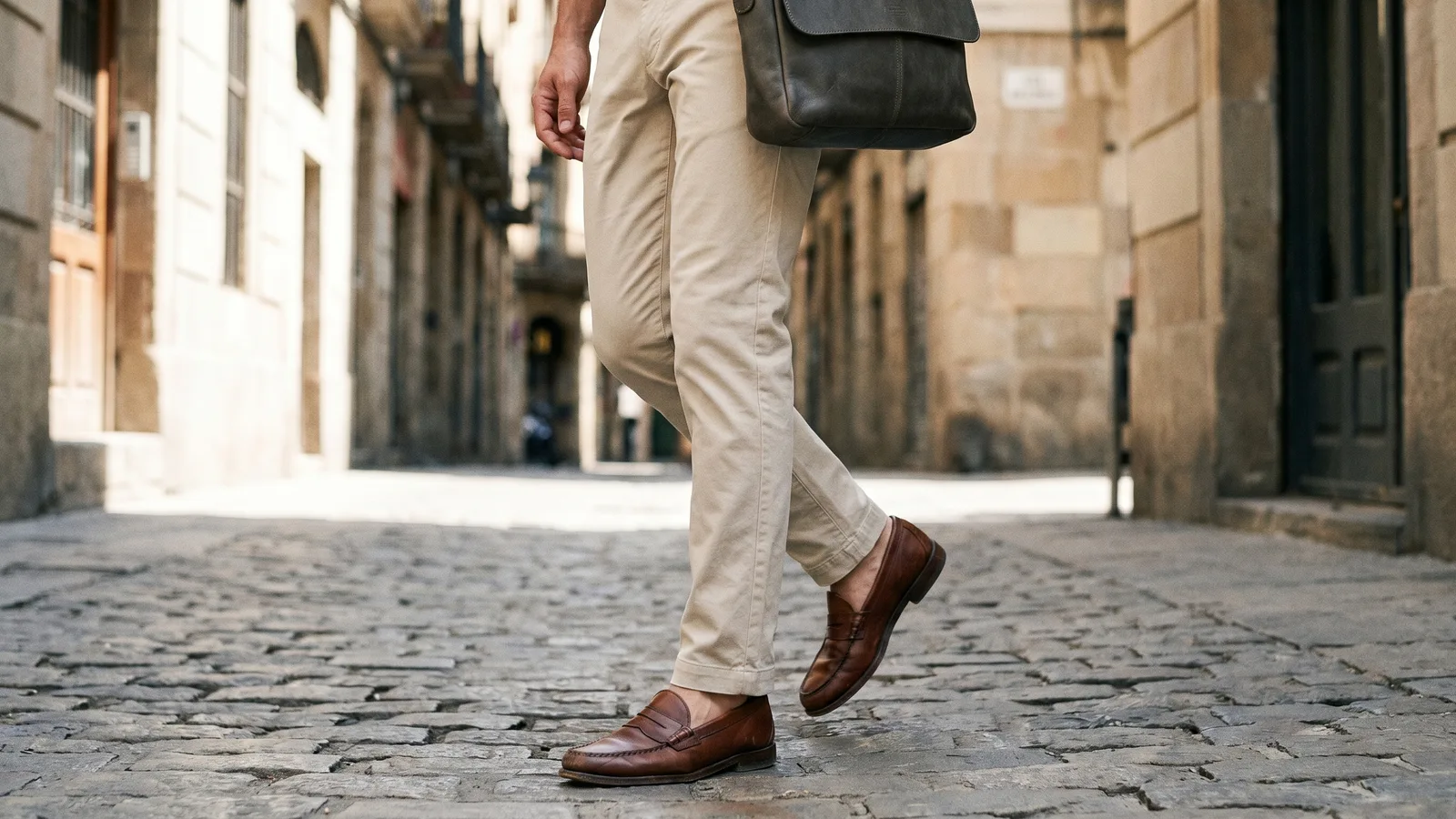
Loafers are the business-casual shoe par excellence: slip-on, sleek, and comfortable, dressy enough for the office but never stiff. Penny and bit loafers in brown or burgundy leather are endlessly versatile, and suede loafers add texture for warmer months and relaxed offices. They work with chinos and dress trousers alike, and they’re the easy answer when you want to look sharp without lacing up.
Boots and monk straps
Clean leather boots, particularly chelseas and sleek lace-up styles, work well in cooler months and add a bit of edge without breaking the dress code, as long as they’re refined rather than rugged work boots. Monk straps, single or double, are a slightly more distinctive option for the man who wants to step beyond the standard derby; they read as considered and polished. Both belong firmly in the business-casual band when kept in brown, black, or burgundy.
Suede and the sneaker question
Suede versions of any of the above add welcome texture and read as intentionally relaxed, which suits business casual well. As for sneakers: this is the other question everyone asks, and the answer is narrow. A minimalist, all-leather, low-profile sneaker in white or a neutral tone, with no chunky sole, no mesh, and no loud branding, can pass in casual and creative offices, worn with chinos or dark trousers. That is the only sneaker that qualifies. Running shoes, basketball sneakers, canvas shoes, and skate shoes do not, no matter how clean they are. If there’s any doubt about your office, default to loafers or derbies, which are never wrong.
Keep them maintained
A scuffed, unpolished shoe undoes a good outfit faster than almost anything else. Brush suede, wipe and occasionally polish leather, and replace shoes once the heels are visibly worn down. Well-kept inexpensive shoes always beat neglected expensive ones.
Belts and socks: the quiet coordinators
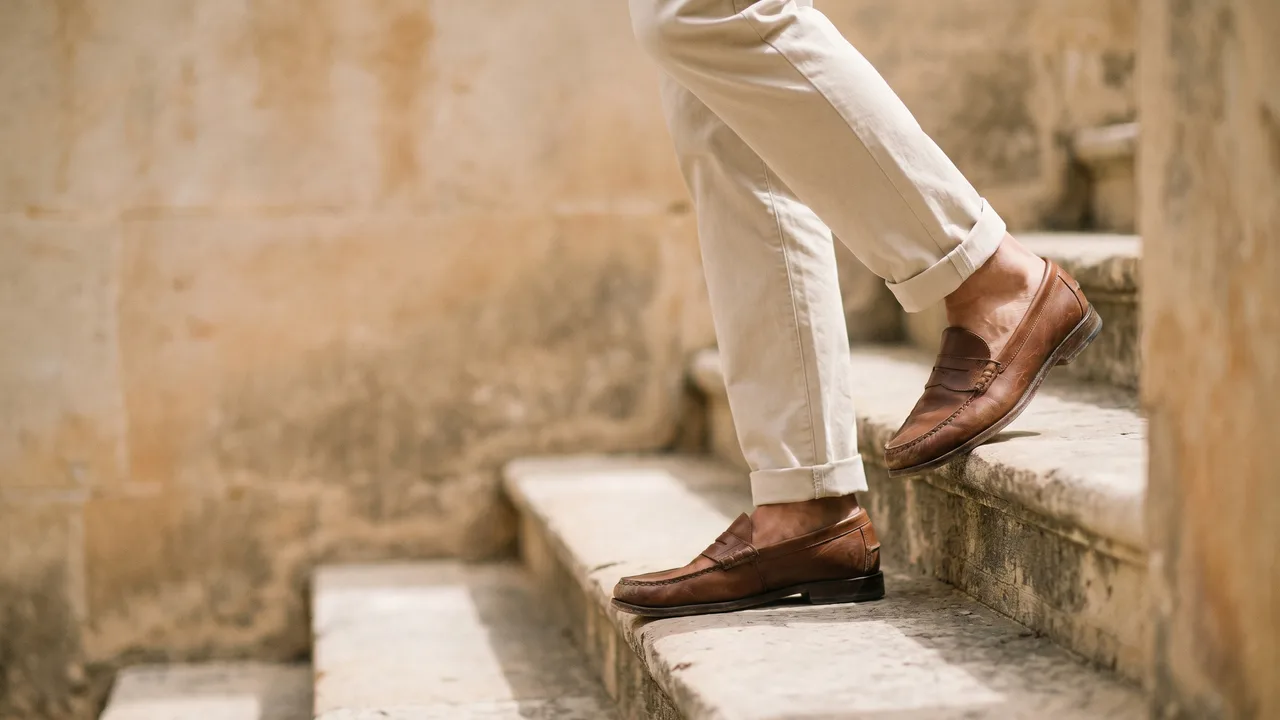
Two small things tie the lower half together. First, the belt: match it to your shoes. Brown shoes take a brown belt, black shoes take a black belt, and the leather finishes should be in the same family. Both should be smooth, simple leather, no oversized buckles or webbing. It’s a small detail that people notice subconsciously when it’s wrong.
Socks should generally match your trousers, not your shoes, to create a clean unbroken line from knee to foot. Solid colors in your trouser tones are foolproof; once that’s handled, a subtle patterned sock is a low-risk way to add personality. The one firm rule is no white athletic socks with dress trousers or chinos, which instantly drags the whole look toward the gym.
Matching shoes to trousers
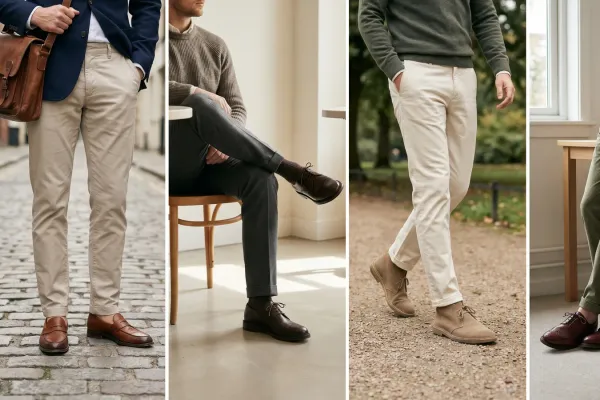
You don’t need a chart, just a few reliable pairings. Brown shoes are the most versatile and pair with khaki, navy, and gray. Black shoes lean dressier and work best with charcoal, gray, and black trousers; they look slightly stiff with tan chinos. Burgundy and oxblood are wildcards that pair with almost everything and add a bit of interest. The general rule of thumb: the darker the trouser, the more black shoes make sense; the more relaxed and earthy the trouser, the more brown and suede shine.
A simple default that always works: tan or navy chinos, a brown derby or loafer, a matching brown belt, and socks in the trouser color. From there you can vary the shirt freely. For how those shirts factor in, see the business casual dress shirt guide.
Trousers and shoes by setting
The same dress code reads differently from one office to the next, and the lower half is where you calibrate it. A few worked pairings show the range.
The conservative office. Where the room leans formal — law, finance, client-facing roles — anchor on charcoal or navy dress trousers with black or dark-brown derbies or oxfords, a matching belt, and dark socks. This is the dressiest end of business casual and reads as serious without a jacket. Wool trousers with a clean leather lace-up is the combination that never looks underdressed in a traditional setting.
The standard office. For the broad middle, navy or stone chinos with a brown loafer or derby is the everyday workhorse. It’s polished but unfussy, and swapping the shirt is all the variation most days need. A mid-gray chino with burgundy loafers is a slightly sharper version of the same idea. This is the zone where chinos do the most work, which is exactly why they earn their own deep dive.
The relaxed or creative office. Where the culture is looser, the lower half can relax with it: olive or tan chinos with suede loafers or clean leather boots, or — if the office genuinely allows it — dark, solid denim with a leather chelsea boot. That denim pairing only works when the wash is dark and the fit is clean, and only where jeans are actually accepted; the jeans question and the specific case of blue jeans are worth reading before you rely on it. When unsure of the room, dress one notch up from what you think it expects — overdressing is forgettable, underdressing is not.
The mistakes that quietly undercut everything
Most lower-half failures come from a handful of repeat offenders:
- Athletic sneakers. Running shoes and chunky trainers are the single most common business-casual mistake. Leather only.
- Scuffed or worn-out shoes. Even the right shoe looks careless when it’s beaten up. Polish and maintain.
- Wrong break. Trousers pooling over the shoe read as sloppy; a quick hem fixes it.
- Too-casual denim. Light washes, fading, and distressing pull jeans out of the dress code even where dark denim might pass.
- Mismatched belt and shoes. Brown belt with black shoes (or vice versa) is a small error that reads as inattention.
- White athletic socks. They undo dress trousers and chinos instantly.
Building the lower half
Get the bottoms and footwear right and the rest of business casual becomes easy. The shortlist is genuinely short: a few pairs of chinos in neutral colors, one pair of dress trousers, a brown derby or loafer, a matching belt, and socks in your trouser tones. That core handles almost any business-casual day, and everything else is variation on top of it.
If you’re assembling this from scratch, the building a business casual wardrobe guide lays out the full kit in order of priority, and the business casual fundamentals cover the principles behind every choice here. From this page, the natural next steps are the trouser deep dives: chinos for business casual, can you wear jeans for business casual, and blue jeans in business casual.