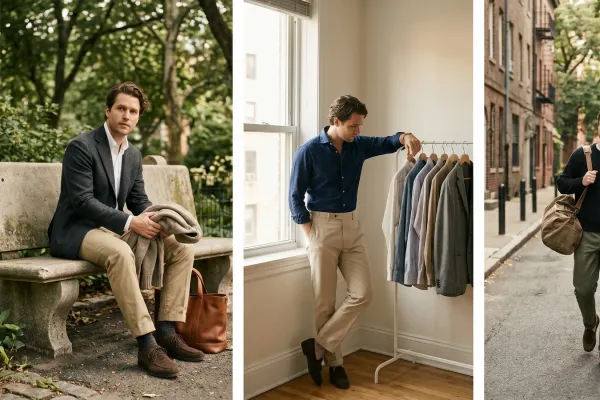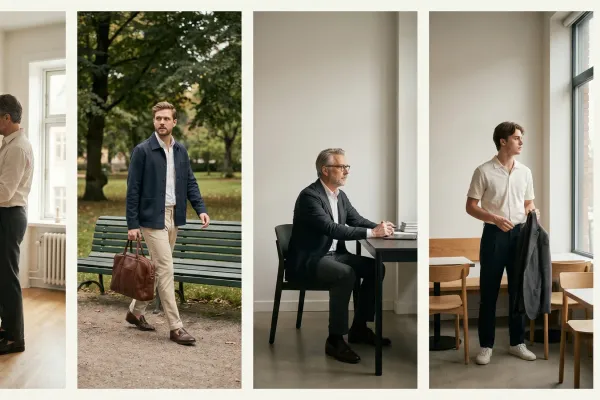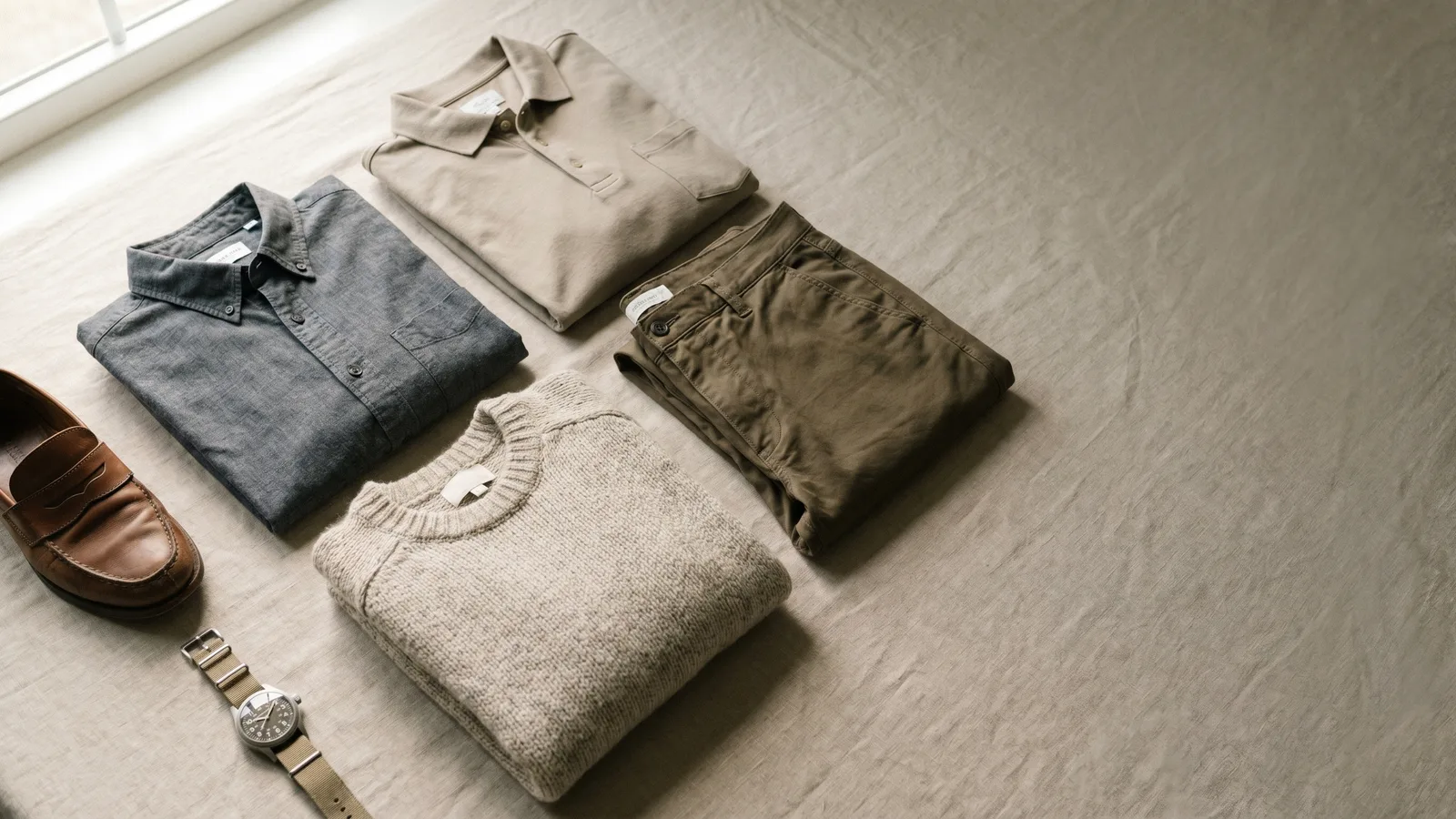
Most men don’t have a clothing problem. They have a closet problem. Open it on a Tuesday morning and there’s plenty hanging there — a dozen shirts, a few pairs of pants, that jacket from a wedding — and still nothing that goes together. So the same three things get worn on rotation while everything else takes up space. The instinct is to buy more. The fix is almost always to buy less, but smarter.
A business casual wardrobe that actually works isn’t large. It’s a small set of pieces chosen so that nearly any top goes with nearly any bottom, and any of it can be dressed up or down depending on the day. That’s the capsule idea, and it’s the single most useful way to think about getting dressed for work without thinking about it. This guide lays out the philosophy, the essential pieces and how many of each, the color logic that makes them interchange, the order to buy in, and the small details — fit above all — that decide whether the whole thing looks intentional or accidental.
Why a small, interchangeable wardrobe beats a big one
The men who always look pulled together rarely own the most clothes. They own the right clothes, and those clothes talk to each other. A closet of one-off purchases — a patterned shirt bought because it was on sale, trousers in an odd shade, a jacket that only matches one thing — fights itself. Each piece is an island. You end up with a lot of garments and very few outfits.
A capsule flips that. When you build around a tight, neutral core, the pieces multiply. Three pairs of trousers and five shirts aren’t eight items; they’re fifteen shirt-and-trouser combinations before you’ve added a sweater or changed shoes. Add a layer and the number doubles again. A dozen well-chosen pieces can dress you for a month without an obvious repeat — and you’ll have spent less, because you bought fewer things and wore all of them.
This is also the calmer way to live. Decision fatigue is real, and the first decision of the day shouldn’t be a struggle. When everything in the closet works with everything else, getting dressed stops being a problem to solve. If you’re still working out what “business casual” even means as a dress code — where the lines sit between it and smart casual or business formal — start with our guide to business casual for men, then come back here to build the wardrobe that fits it.
The essentials: what you actually need
Here is the core. Quantities are starting points, not rules — adjust to your climate and how often you’re in an office — but this list will carry the great majority of men through a full work week with room to spare. For the longer, item-by-item breakdown, see our cluster on men’s business casual essentials; what follows is the overview.
Shirts (4–6)
Shirts do most of the visible work and carry most of the variety, so this is where to spend your count. Aim for a mix: two or three crisp button-downs in white and light blue, which are the backbone of the category and go with everything; one or two Oxford-cloth or chambray shirts that read a touch more relaxed; and a fine-gauge polo or two for the warmer, less formal end. Keep patterns quiet — a thin stripe or subtle check at most. Loud shirts are the ones that end up unworn because they only match one thing. For the full range of collars, fabrics, and how to judge a good one, see our pillar on the business casual dress shirt.
Trousers (2–3)
You need fewer trousers than shirts because they vary less and you can wear them more than once between washes. A pair of well-fitting chinos in stone or tan, a pair in navy or charcoal, and ideally one pair of tailored wool trousers in gray covers the entire spectrum from a relaxed Friday to a client meeting. These three anchor everything above them. We go deeper on cuts, breaks, and fabrics — and how trousers pair with the right footwear — in the trousers and shoes pillar.
Footwear (2 pairs)
Two pairs of leather shoes will quietly handle almost any business casual day: a pair of brown leather derbies or loafers for the everyday, and a slightly dressier pair — dark brown or oxblood — for the days that call for it. Leather sneakers in white or a muted tone make a sensible third pair if your office leans casual. Avoid black unless your workplace is genuinely formal; brown is more versatile and more forgiving across an earth-toned wardrobe.
Knitwear and layers (1–2)
A layer is what turns a shirt into an outfit and stretches your shirt count further. A fine-gauge merino crewneck or V-neck in navy or gray pulls over a collared shirt and instantly looks considered. A cardigan or a quarter-zip knit works too, depending on your taste. One good sweater does a lot; two gives you options through the cooler months.
A blazer or sport coat (1)
One unstructured navy blazer is the highest-leverage piece in the wardrobe. Thrown over a shirt and chinos, it lifts the whole outfit for a meeting, a lunch, or any day you want to signal a little more intent — then it comes off and you’re back to relaxed. Unstructured (soft shoulder, little padding) is the right starting point because it’s comfortable, travels well, and reads modern rather than corporate. Navy first; a gray or earth-toned second comes much later, if ever.
Accessories (a few, quiet)
A brown leather belt that roughly matches your shoes, a simple watch, and that’s most of it. Business casual rewards restraint here. One of the most common questions men ask is what to do about a tie — and the honest answer for most business casual settings is that you don’t need one at all; an open collar under a blazer is the modern default. The point of accessories in this wardrobe is to be unnoticed and correct, not to be the focus.
Color strategy: build so everything matches
This is the quiet engine of the whole system, and it’s worth getting right before you buy anything. The reason a capsule produces so many outfits from so few pieces is that the pieces share a palette. Keep your trousers and shoes in neutral, anchoring tones — navy, gray, charcoal, tan, stone, brown — and let your shirts carry whatever variation you want. When the bottom half of every outfit is a neutral, every shirt you own works with every pair of trousers you own. Nothing clashes because nothing is fighting for attention.
A useful working palette: navy, gray, white, light blue, tan, and a touch of olive. Almost any combination drawn from that set looks deliberate. The mistake men make is buying a “statement” piece in an off color — a maroon trouser, a bright jacket — that then needs its own dedicated outfit built around it. In a small wardrobe, a piece that only matches one other thing is dead weight. Save the personality for the details: the texture of a knit, the grain of a shoe, a subtle shirt pattern. Those add interest without breaking the interchange.
How to build it — order and budget
You don’t buy a wardrobe in a weekend, and you shouldn’t try. Build in the order of how often you’ll wear each thing, so every purchase starts earning immediately.
- Trousers and shoes first. They’re the foundation everything sits on, and they vary least, so getting them right early stabilizes the whole wardrobe. One versatile pair of chinos and one pair of brown leather shoes is a working base on day one.
- Shirts next. Add white and light blue button-downs before anything else — they’re the pieces you’ll reach for most. Expand into Oxford and chambray once the basics are covered.
- A layer, then the blazer. A single navy sweater and one navy blazer roughly double the range of what you already own. These are where a slightly bigger spend pays off, because they’re visible and you’ll wear them constantly.
- Fill gaps last. Only after living in the core for a few weeks will you actually know what’s missing. Buy to a real gap, not a hypothetical one.
On budget: spend where it shows and lasts, save where it doesn’t. The blazer, the shoes, and the trousers are worth more of your money because they’re structural and worn hard; an undershirt or a basic polo is not. The genuinely cheaper path is to own fewer, better things and wear them out — a closet full of bargains you never reach for is the most expensive wardrobe there is. If you want a tightly defined, count-by-count version of this build, our business casual capsule wardrobe essentials list lays out exactly what to buy and in what quantity, and our broader men’s business casual capsule wardrobe guide walks through the same approach for different office cultures and climates.
Where to spend and where to save
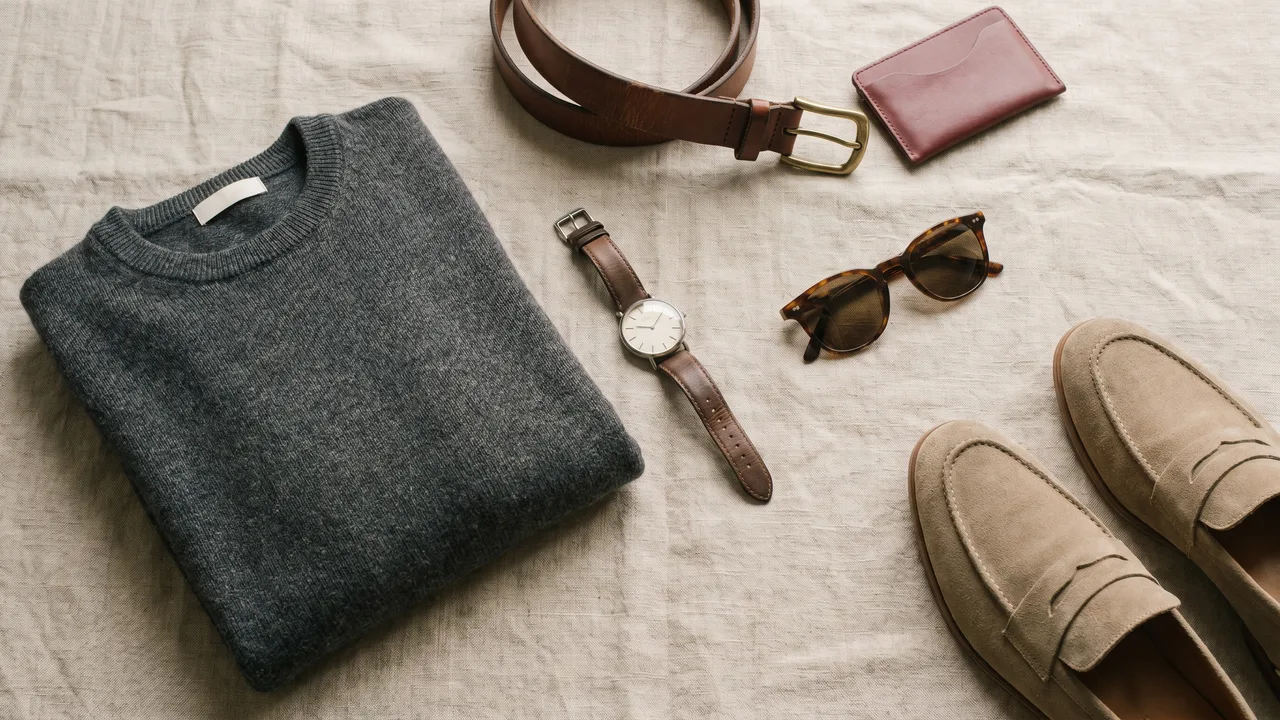
Not every piece deserves the same share of your money, and knowing the difference is most of what separates a wardrobe that looks expensive from one that cost a fortune and doesn’t. Think in three rough tiers, regardless of what you can afford in total.
Spend here. Leather shoes and the blazer are the pieces that reward investment most, because they’re the most visible, the most structural, and the longest-lived. Good shoes, resoled and cared for, outlast several cheap pairs and look better the whole time; a well-made blazer holds its shape for years. Trousers sit just below — worth buying well, especially the wool pair, since fabric and construction show plainly in how they hang.
Spend on the tailor. This is the line most men skip, and it’s the highest-return money in the whole wardrobe. Tailoring is cheap relative to the clothes and it makes everything you own look like it was bought for you. Budget for it the way you’d budget for a garment.
Save here. Undershirts, basic polos, socks, and the more casual cotton shirts are fine at modest prices — they wear out, they’re rarely the focus, and the difference between cheap and expensive versions barely registers under a sweater or a jacket. Put the money you save on these toward the tier above.
The principle underneath all three tiers is the same one that built the wardrobe: fewer, better, worn hard. Spreading a fixed budget thin across many items leaves you with a closet of compromises; concentrating it on the pieces that carry the look leaves you with a wardrobe that punches well above what you paid.
How a dozen pieces become weeks of outfits
It’s worth seeing the math, because it’s more generous than it feels. Take a modest core: three trousers, five shirts, one sweater, one blazer, two pairs of shoes. The shirts and trousers alone give fifteen combinations. Add or remove the sweater and you’ve roughly doubled them. Add or remove the blazer and you’ve doubled them again. Change the shoes and the count climbs further still. You are well past a month of distinct, work-appropriate outfits from twelve items — and no one in the room is counting.
That abundance is the entire payoff of building this way. The wardrobe feels deep not because it’s large but because it’s coherent. Every morning you’re choosing from a set where every choice already works, which is why men who dress like this seem to do it effortlessly. The effort happened once, at the buying stage.
A week of outfits from twelve pieces
Abstract math is easy to nod along to and hard to believe. So here is a concrete week, built from exactly twelve pieces: white, light blue, and chambray shirts; a navy polo and an Oxford button-down (five shirts); tan chinos, navy chinos, and gray wool trousers (three trousers); a navy merino sweater; a navy blazer; brown loafers and dark brown derbies (two pairs of shoes). Nothing here repeats an obvious look across the week, and none of it strains.
- Monday — a meeting day. Light blue shirt, gray wool trousers, dark brown derbies, navy blazer. The blazer and wool trousers carry the formality without a tie; the open collar keeps it modern.
- Tuesday — ordinary office day. White shirt, tan chinos, brown loafers. The plainest possible combination, and still sharp because everything fits and the palette agrees.
- Wednesday — cooler, heads-down. Chambray shirt under the navy merino sweater, navy chinos, brown loafers. The sweater turns two casual pieces into a considered outfit.
- Thursday — a touch more dressed. Oxford button-down, gray wool trousers, dark brown derbies. Crisper than Tuesday, less formal than Monday, with no new pieces involved.
- Friday — relaxed end of the week. Navy polo, tan chinos, brown loafers. The easiest day, and it still reads intentional because the polo and chinos were chosen to belong with everything else.
Five days, twelve pieces, and the blazer and sweater have only been touched twice between them — there’s plenty of unused range left for the following week. This is the mix-and-match claim made literal. For more example weeks built around different office cultures, see the men’s business casual capsule wardrobe guide.
Fit is the multiplier
Everything above assumes one thing that does more than any purchase: the clothes fit. Fit is the multiplier that decides whether a modest wardrobe looks expensive or whether an expensive one looks cheap. The same shirt is sharp when the shoulder seam sits where your shoulder ends and the body skims rather than billows — and shapeless when it’s a size too big. The same trousers look tailored with a clean break and sloppy when they puddle over the shoe.
Almost nothing off the rack fits perfectly, and that’s expected. Budget for a tailor the way you budget for the clothes themselves. Having shirts taken in through the body, trousers hemmed to the right length, and a jacket’s sleeves and waist adjusted costs a fraction of the garments and transforms how they look. The general rule, and it’s a reliable one: well-fitting inexpensive clothes will always beat poorly fitting expensive ones. If you’ve ever wondered how some men just look better in the same basic pieces, fit is usually the answer, not the price tag.
Seasonal and climate variation
A common worry is that a capsule means freezing in winter and sweating through summer — that staying small forces you to choose a season. It doesn’t. The core doesn’t change; it flexes, and it does so mostly through layers and fabric weight rather than through a second wardrobe.
In warmer months, you simply remove rather than add. The blazer comes off and the sweater stays in the drawer; you live in shirts and trousers, lean on the polos and the chambray, and let the lighter end of your palette do more work. If you run hot, one or two breathable warm-weather shirts — a linen-blend or an open-weave cotton — are the only genuinely seasonal additions worth making, and they still obey the neutral palette so they slot into the same combinations.
In colder months, you add over the top of the same core rather than replacing it. The merino sweater layers under the blazer; the wool trousers come forward; a second knit and an overcoat handle the cold without touching the rest of the wardrobe. The shirts, the chinos, the shoes all stay exactly the same — they’re just wearing more company. This is the quiet efficiency of building on neutrals and natural fibers: the wardrobe spans the year on a handful of seasonal swaps, not two parallel closets. For more on which fabrics earn their place in each season, the men’s business casual essentials guide goes piece by piece.
Maintaining and evolving the wardrobe
A capsule isn’t a museum. It’s a living set that needs light, ongoing care to stay sharp. Rotate your shoes rather than wearing the same pair daily, and they’ll last years longer; cedar shoe trees and the occasional polish do more than most men realize. Wash shirts less aggressively and hang or press them so collars stay crisp. Wool trousers and knitwear want air and rest between wears, not constant laundering.
Evolving it is mostly a matter of replacing, not accumulating. When a shirt frays at the collar, replace it with the same kind of shirt — resist the urge to buy something new and untested in its place. Add a piece only when you’ve felt a real, repeated gap: a warmer layer for winter, a second blazer once the first has proven itself. The discipline that built the wardrobe is the discipline that keeps it useful. Done right, you stop thinking about clothes altogether, which was the point from the start — to look pulled together without spending any energy getting there.
For the broader principles of dressing well that sit underneath all of this, our business casual fundamentals pillar is the natural next read. From here, the three deeper guides — the capsule wardrobe overview, the essentials list, and the core pieces breakdown — take each part of this further.