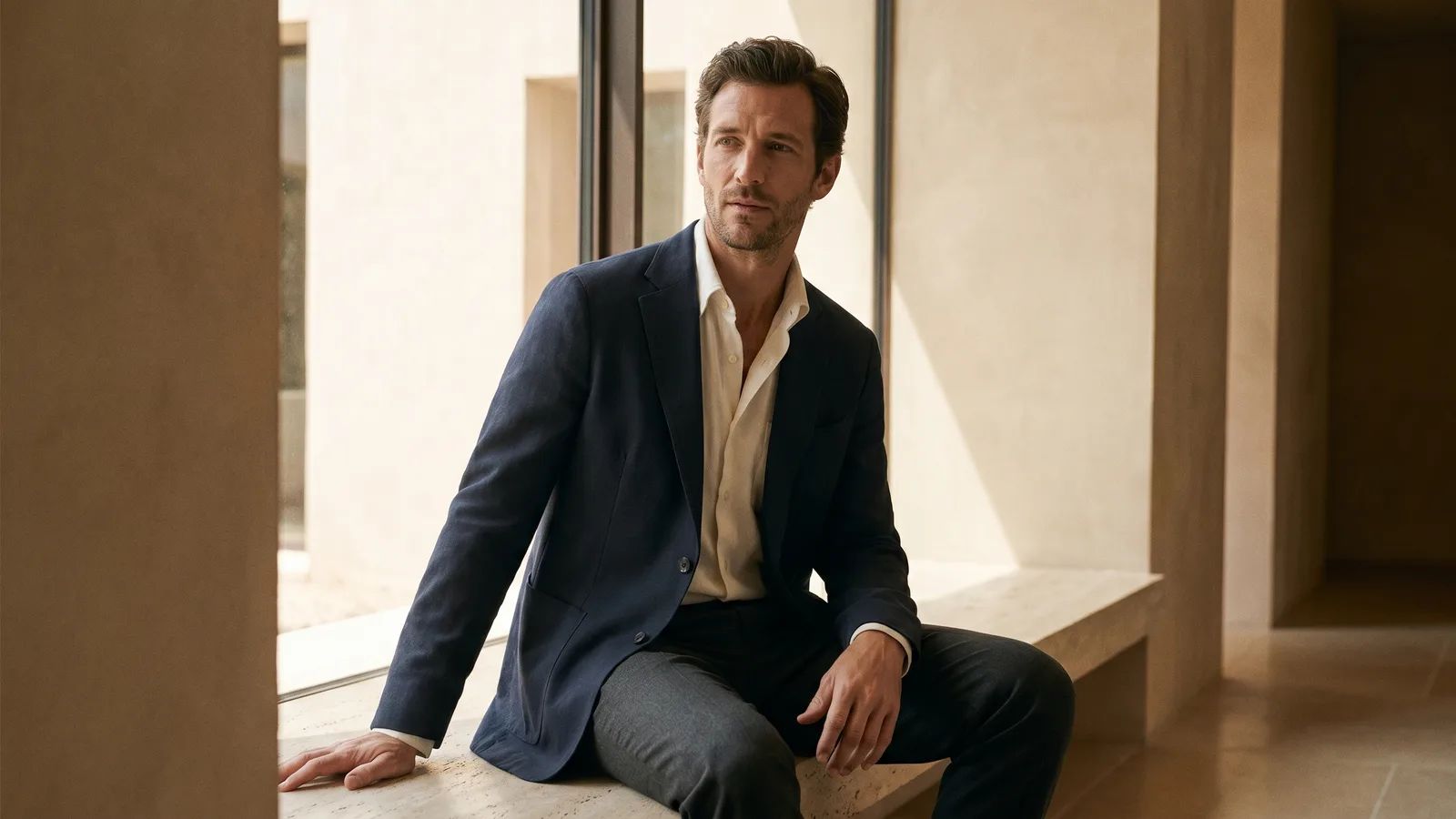
You take the tie off, look in the mirror, and something is wrong. The collar splays out flat against your chest, the points droop, and the whole thing slumps open like it gave up. You look less relaxed and more like you forgot half your outfit. That gap between the collar and your neck — the one a tie used to fill — now just looks like absence.
This is the quiet problem with the no-tie look, and it is the reason so many men feel uneasy dressing down a dress shirt. The question that floods forums isn’t really “can you wear a dress shirt without a tie” — it’s “why does mine look sloppy when I do?” The honest answer is that the tie was never the only thing holding your collar up. Once it’s gone, the collar has to stand on its own, and most shirts aren’t built to let it.
The good news: this is a structural problem, and structural problems have clean fixes. A well-chosen open collar looks sharper, more modern, and more at ease than a tie ever did. Below is everything that goes into getting it right — why the open collar slumps, how to choose shirts that hold their shape, the hardware that keeps a collar crisp, how to wear a suit or blazer without a tie, and when to keep the tie on after all.
Why an open collar looks sloppy — or sharp
Spend ten minutes in the menswear forums and you’ll find the same worry phrased a dozen ways: is it bad form to wear a dress shirt without a tie? Is wearing suits without a tie unprofessional now? People sense that the no-tie look can fall flat, but they blame the missing tie. The real culprit is collar structure.
A necktie does two jobs. The obvious one is decorative. The hidden one is mechanical: the knot sits in the collar band and braces the two collar leaves upright and together. Pull the tie out and you remove that brace. A soft, unstructured collar — the kind on a lot of casual and slim-fit shirts — has nothing left to hold it, so it folds outward, the points curl, and the front gaps open. That collapse is what your eye reads as “unfinished.”
A sharp open collar does the opposite. The leaves stand slightly proud of the chest, the points hold their line, and the opening at your throat looks framed rather than empty. Nothing about it says a tie is missing — it looks like a complete idea on its own. The difference between the two is almost entirely built into the shirt before you put it on, which is why choosing the right shirt matters more here than in almost any other part of business casual.
How many buttons to undo
Start with the simplest lever, because it’s the one people most often get wrong. With no tie, undo the top button only. One.
That single open button does the whole job. It signals that you’ve deliberately relaxed the collar, it lets the collar sit naturally, and it keeps the look firmly professional. A second undone button changes the message entirely — it opens the chest, drops the look into evening or going-out territory, and in an office it reads as trying too hard. The forum threads about wearing shirts “fully unbuttoned” or with a tee underneath are a different style conversation altogether; for business casual, the answer is one button, full stop.
There’s nuance to it — what to do under a blazer, how it changes with collar type, what to do if your top button feels too tight — and we cover all of it in how many buttons to undo (and when). But the headline rule is easy to remember and hard to improve on: one button, and let the collar’s own structure handle the rest.
Choosing a shirt that holds an open collar

This is where the no-tie look is won or lost. A shirt that stands open is a specific kind of shirt, and once you know what to look for, you’ll never again wonder why one shirt looks crisp tieless and another collapses.
Collar type does most of the work
The single most reliable choice is the button-down collar. The little buttons that anchor the collar points to the shirt body were invented to keep collars from flapping — they hold the points down and the leaves up, which is exactly the problem you’re solving. A button-down worn open looks intentional almost by default. It reads slightly more relaxed than a point collar, which suits the no-tie register perfectly.
If you prefer a non-button-down collar, choose a spread or semi-spread with real backbone. A point collar with long, soft leaves is the worst offender for splaying; a spread collar with a shorter, firmer leaf sits flatter and stands better. The thread what is the most normal-looking business shirt collar comes up often, and the honest answer for tieless wear is: a medium spread or a button-down. Both look correct open and closed.
We go deeper into collar styles and how they behave in our pillar on collars and stays — worth reading alongside this if the collar is where your no-tie look keeps falling apart.
Interlining and collar construction
Inside every collar is a layer of stiffening called interlining. You can’t see it, but it determines everything about how the collar holds up. There are two broad types:
- Fused collars, where the interlining is bonded to the fabric with adhesive. These are firmer and hold a crisp line on their own — generally the better choice for tieless wear because they stand without help.
- Sewn (or unfused) collars, where the interlining is stitched in. These feel softer and more natural but are more prone to slumping when open.
Most off-the-rack dress shirts are fused; if you’re buying with the open collar in mind, that firmness is a feature, not a flaw. The thread asking what’s this inside my collar and what is its purpose is, in effect, asking about interlining — and the answer is that it’s the difference between a collar that stands and one that flops.
Fabric weight matters too
A heavier, more substantial fabric holds a collar better than a thin, drapey one. Oxford cloth is the classic example: it has body, it stands open beautifully, and it pairs naturally with a button-down. A featherweight poplin will collapse more readily. This is also why the much-asked best white dress shirt for a suit with no tie tends to land on a structured oxford or a firm twill rather than a flimsy dress poplin. For more on choosing shirts that earn their keep across business casual, see our dress shirt pillar.
Keeping the collar crisp: stays and hardware
Even the right shirt benefits from a little help, and this is where collar hardware earns its place. The forums are full of men hunting for collar stays that actually hold up and debating plastic or metal — clear evidence that this small detail matters more than it looks.
Collar stays are the thin strips that slide into the underside of each collar point through a small slot. They keep the points straight and stop them curling. Most shirts ship with flimsy plastic ones; the upgrade men keep recommending is metal stays. They’re heavier, hold their shape, won’t warp in the wash or under an iron, and add just enough weight to help the collar sit flat against the chest rather than flaring up — which is exactly the problem an open collar creates. The trade-off some note is that very firm stays can press against the fabric over time, so quality and proper sizing matter.
A couple of practical notes that come straight from how people actually use them:
- Take them out before washing. The repeated do you take your collar stays out question has a clear answer: yes, for metal stays especially. It protects both the stay and the shirt.
- Size them right. Stays come in lengths to match collar-point length. A stay that’s too short does nothing; one too long won’t seat. Match the stay to the point.
There’s a fuller breakdown of the options — metal versus plastic, magnetic versus slot-in, and the alternatives for keeping a collar in line — in keeping an open collar in place: the hardware. For the no-tie look specifically, the takeaway is simple: a structured shirt plus a decent pair of metal stays will keep your collar standing all day, which is most of the battle.
The no-tie suit and blazer look
The biggest no-tie question of all is the suit. Suits without ties — is that the new standard? Is a suit with no tie acceptable for smart casual? The reddit and quora threads circle this constantly, and the answer is yes — the suit-without-a-tie look is now thoroughly established and, done right, looks modern and confident rather than incomplete.
But the suit raises the stakes, because a suit jacket frames the collar and draws the eye straight to it. A slumping collar that you might get away with on a standalone shirt becomes glaring under a lapel. So the rules tighten:
- The collar must be structured. A spread or button-down with firm interlining. Under a jacket, a collapsing point collar looks especially wrong.
- The collar should reach the lapel. A spread collar whose leaves sit near or just under the jacket’s lapel looks intentional and balanced. A narrow, droopy collar swimming in open space under a wide lapel looks lost.
- One button open, as always. Same rule as the standalone shirt.
- Everything else has to be sharp. Without a tie, the rest of the outfit carries the formality. Crisp shirt, clean fit, polished shoes. The recurring forum debate — jacket, no tie vs. tie, no jacket — generally lands on the jacket being the stronger move, but only when it’s worn well.
The full method for the suit specifically — fabric, collar, shoes, and the contexts where it works — is in wearing a suit without a tie, the right way. For the broader question of dressing business attire down a notch without losing authority, see business attire without a tie, and for a fast orientation, business casual without a tie: a quick guide.
When no-tie works — and when a tie is still expected
No-tie is the default for most modern business casual settings, but it isn’t universal. Reading the room is part of doing it well. The much-searched is business casual tie or no tie really comes down to context, and a few clear lines help.
No tie is right for most day-to-day office work in business casual environments, internal meetings, creative and tech industries, and smart-casual social events. In these settings a tie can actually read as overdressed or stiff.
Keep the tie for conservative-industry interviews (finance, law, traditional corporate), court, funerals, black-tie or formal events, and any meeting where you know the other side will wear one. The recurring AITA for making my boyfriend wear a tie to a black-tie event thread is a useful reminder that some occasions genuinely require it, and showing up without one reads as not taking the event seriously.
The safest default in any ambiguous situation: bring the tie, wear it in, and read the room. You can always slip it off and pocket it if everyone else is open-collared. You cannot produce a tie you left at home. Erring toward the tie costs you nothing; erring against it can cost you in exactly the rooms where it matters most.
Looking intentional, not like you forgot the tie
Pull all of this together and the open collar stops being a compromise and becomes a deliberate, confident choice. The men whose no-tie look reads as sharp aren’t doing anything mysterious — they’ve simply removed the things that make it read as careless:
- A structured collar — button-down or firm spread — that stands on its own.
- A shirt with enough fabric weight and interlining to hold its shape.
- Metal collar stays, sized correctly, keeping the points crisp all day.
- One button undone, never two.
- Sharp fit and polished shoes carrying the formality the tie used to.
- Good judgment about the few rooms that still call for a tie.
None of it requires fuss once the foundations are in place. That’s the whole appeal: an open collar should look like you didn’t have to think about it, which is only possible when the structure does the thinking for you. Get the shirt and the collar right, and the no-tie look becomes the easiest sharp thing in your wardrobe.
If you’re building the wider wardrobe around this, start with the business casual fundamentals, then refine the pieces that anchor the open collar: the dress shirt and the collar and stays themselves. The tie was never the point. A collar that stands on its own is.