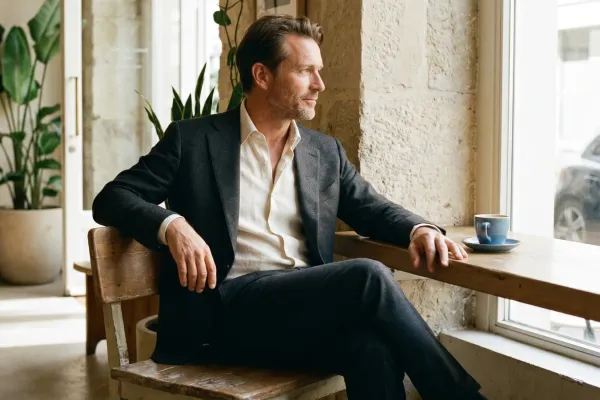
The dress code says business, but the office wears open collars
You work somewhere that calls itself a business or professional environment, but half the room has skipped the tie and looks completely appropriate doing it. So you are left guessing: is business attire tie or no tie now, and if you go without, will you read as relaxed and current, or as the guy who is not taking it seriously? Get it wrong in a workplace and the stakes feel higher than at a weekend lunch.
The reassuring part is that the open collar has become genuinely professional in most modern workplaces. The trick is making it look like a confident choice rather than a missing piece, and that comes down to where you put the polish once the tie is gone. This guide is about dressing for work without a tie and still looking like you mean business. For the broader topic, the no-tie pillar guide is the hub.
Yes, no-tie can be fully professional now
The necktie used to be the default signal of a serious, dressed-for-business man. That has shifted. Across finance-adjacent roles, law-adjacent roles, media, consulting, and most client-facing work, the open-collar look is now standard and reads as entirely professional. Leadership wears it. Clients wear it.
What changed is where professionalism is read from. It moved off the tie and onto the things around it: the fit of the jacket and shirt, grooming, the condition of the shoes, and whether the outfit looks intentional. A man in a sharp, well-fitted open-collar setup reads as more put-together than a man in a baggy suit with a tie. The tie is no longer the proof of effort. The whole package is.
That said, the open collar is not universal. The most conservative environments, certain formal events, and some traditional client bases still expect a tie. The skill is reading which room you are in, which the last section covers.
Replacing the tie’s authority signal
A tie carried a quiet message: effort, seniority, formality. Remove it and you want to put that message back through other channels, or the outfit can read as merely undressed rather than deliberately relaxed.
Fit first. Nothing signals “in command” like clothes that fit. A jacket with the shoulders landing right and a shirt that sits close through the body does more for authority than any accessory. Without a tie drawing the eye to a tidy center line, a poor fit shows more, so this matters even more than usual.
A jacket reframes everything. A sport coat or blazer over an open collar is the single most reliable way to look professional without a tie. The lapels frame a higher, tidier neckline and instantly raise the formality. If you can wear a jacket in a tie-optional office, it does a lot of the lifting.
Shoes carry the polish. Clean, well-kept leather shoes are doing more work in a no-tie outfit than in a suited-and-tied one, because there is less else signaling formality up top. Scuffed shoes undercut the whole look.
Grooming closes the gap. A neat haircut, tidy facial hair, and a pressed shirt read as control and care, which is exactly what the tie used to imply.
The collar is your focal point now
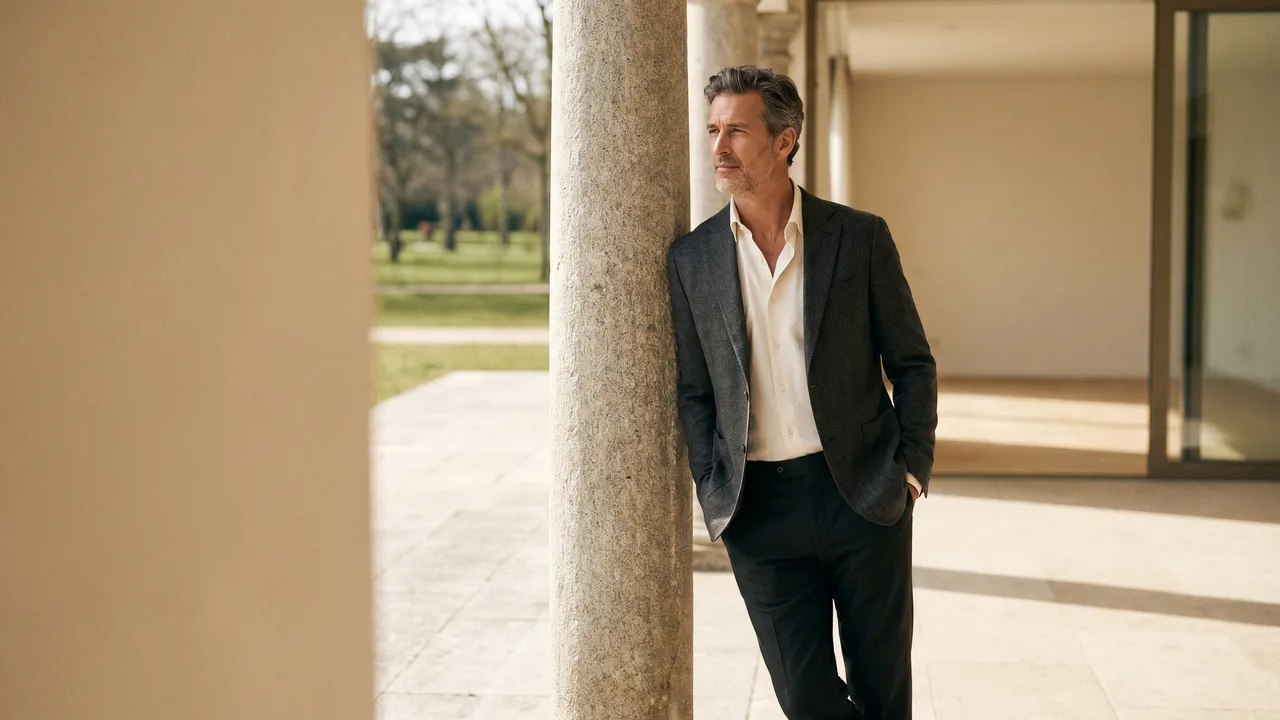
In a professional setting without a tie, your collar sits right under your face with nothing competing for attention. It becomes the focal point of the outfit, and a weak collar undermines the authority you are trying to project.
Two priorities keep it sharp:
Choose a structured collar. A spread or semi-spread collar with some body stands up and frames the open neckline cleanly. A soft, flimsy collar splays and curls, which reads as careless in exactly the setting where you want to read as composed. Our collared shirt guide covers the collar types worth owning.
Keep the collar stays in. With no tie knot to prop the collar up, the stays are what hold the points flat and the line crisp through a full day. If yours are missing, see where to put collar stays. If the collar still gapes, the answer is structure, not a tie substitute clipped to the shirt; our piece on open-collar hardware explains what actually holds an open collar in shape.
Undo the top button only, or at most the top two in a relaxed office; one is the professional default. The full breakdown is in how many buttons to undo.
When the suit comes into it
If your business attire involves a suit and you want to wear it without a tie, the rules tighten, because a formal suit is built around the assumption of one. Softer, less formal suits in casual colors wear well open-collar; sharp, dark, formal suits can look like they are missing a piece. Because that case has its own playbook, we cover it fully in wearing a suit without a tie.
Reading the room: when to keep the tie on
The open collar is the default in most workplaces, but a few situations still call for a tie, and matching the moment is more professional than committing to one approach.
- Formal events and ceremonies: wear the tie.
- Conservative clients or industries: a tie signals respect for their norms.
- High-stakes moments, like a pitch, board meeting, or first impression with leadership: dressing up one notch with a tie can serve you.
- An explicit dress code: follow it; do not freelance.
The reverse is also true. In a relaxed office, an unnecessary tie can read as overdressed or out of step. The goal is to match the room, not to win an argument with it. The no-tie pillar guide walks through where the open collar fits across settings.
The interview question
Interviews are where the tie-or-no-tie decision feels highest-stakes, because you are making a first impression on people whose norms you do not yet know. The instinct to overthink it is understandable, and there is a clean way to resolve it.
The governing principle is to dress for the company you are interviewing with, not for your own comfort. For a conservative or formal employer, a tie is the safer choice; it signals that you take the meeting seriously, and you can always loosen later if the room turns out to be relaxed. For a creative, tech, or openly casual workplace, an open collar with a jacket can actually read as a better cultural fit than a tie, which might look stiff or out of step.
When you genuinely cannot tell, dressing one notch up rarely hurts. A jacket with a tie that you are prepared to remove gives you the most flexibility in the moment. What you want to avoid is showing up clearly underdressed for a formal employer; that is the only version of the mistake that is hard to recover from. Beyond the tie itself, the same fundamentals carry: fit, a clean shirt with a structured collar, polished shoes, and good grooming say more about you than the presence or absence of a strip of silk.
Day-to-day in a tie-optional office
Once you are inside a tie-optional workplace, the daily challenge shifts from one big decision to small, consistent ones. The men who look most professional without ties are not doing anything dramatic; they are simply consistent.
They keep a jacket on hand for the days a meeting elevates, so they can dress up a level without a tie. They keep their shirts pressed and their collars structured, because that is where the eye goes. They keep one good pair of shoes in rotation and actually maintain them. And they read each day’s calendar, dressing slightly sharper when leadership or clients are involved and slightly more relaxed when the day is internal.
This is the quiet skill of the open collar at work: not a single right outfit, but a reliable baseline you can dial up or down. Get the baseline right and you stop thinking about it, which is the entire point of dressing well without a tie.
The short version
Business attire without a tie is genuinely professional in most modern workplaces, as long as it looks deliberate. The authority the tie used to carry moves to fit, a jacket, clean shoes, and grooming, and your collar becomes the focal point, so keep it structured with the stays in. Undo one button, lean on a sport coat where you can, and read the room for the moments a tie still serves you. For the full picture, start at the no-tie pillar guide.