
The dress code no one will define for you
Few instructions cause as much quiet stress as “smart casual.” You get it on a wedding invitation, in a calendar invite for a client dinner, on a company offsite agenda. It tells you that jeans-and-a-tee is too little and a suit is too much, and then it stops. It names a target without giving you the coordinates.
The confusion is reasonable. The phrase is two words that pull against each other. “Smart” asks for polish; “casual” gives you permission to relax. Nobody hands you the ratio. And because the dress code shows up in wildly different settings, the same two words can mean a blazer at one event and a clean knit at another.
This page is the definition you were never given. Not a mood board, not a shopping list, but a working understanding of what the dress code actually asks, so you can decode it on sight. For full outfit recipes and a head-to-toe primer, our smart casual guide goes deeper.
What smart casual actually means
Here is the cleanest way to think about it: smart casual is dressed-up casual clothing, not dressed-down formal clothing.
That distinction does most of the work. You are not stripping a suit down to its components. You are taking your everyday wardrobe and elevating it, one notch at a time, until it looks deliberate. The starting point is casual. The job is to add intent.
Three levers do the elevating:
- Fit. Clothes that follow the line of your body read as smart, almost regardless of what they are. A plain t-shirt that fits well looks more considered than an expensive shirt that billows.
- Material. Natural fibers and a bit of structure signal effort. Wool, cotton twill, oxford cloth, and fine-gauge knits look smart; jersey, fleece, and athletic synthetics read casual.
- Condition. Smart casual is unforgiving of neglect. Pressed, clean, and unscuffed beats expensive-but-rumpled every time.
Pull one or two of those levers and an ordinary outfit crosses the line. That is the whole mechanism.
Where it sits between the other dress codes
It helps to see smart casual as a point on a spectrum rather than a fixed costume. From most relaxed to most formal, the order runs roughly:
Casual → smart casual → business casual → business professional → formal.
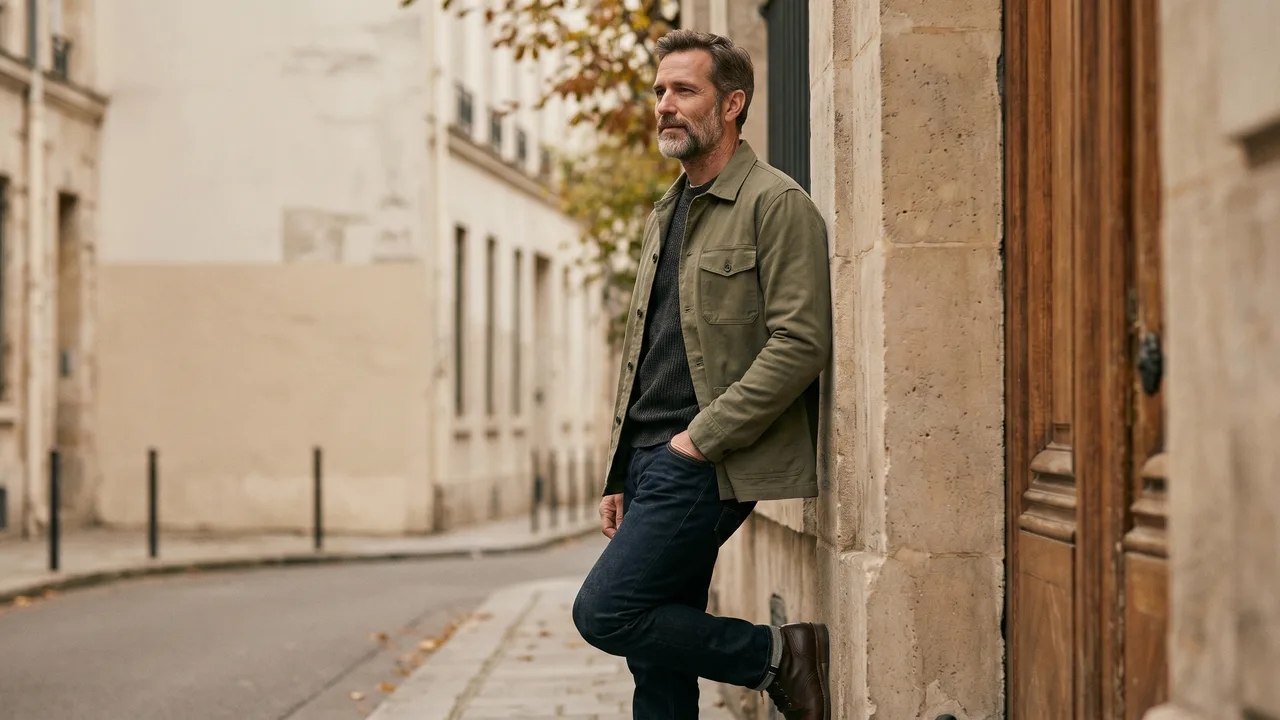
Notice that smart casual sits below business casual, not above it. This trips up a lot of men. Business casual is workplace clothing with the tie removed: chinos or wool trousers, a collared shirt, leather shoes, often a blazer. Smart casual borrows freely from that kit but allows more room to breathe — a knit polo instead of a dress shirt, dark denim instead of trousers, leather sneakers instead of oxfords.
A useful test: business casual is what your conservative manager wears to the office. Smart casual is what your stylish friend wears to a nice dinner. The pieces rhyme; the attitude differs. If you only remember one thing about how the two relate, remember that smart casual gives you more personality, not more formality.
The pieces that live inside the dress code
You do not need a separate wardrobe. A small, versatile set of pieces covers nearly every smart casual occasion you will face.
On top: an oxford cloth button-down, a fine-gauge merino sweater or polo, a crisp t-shirt under a layer. Collared options skew smarter; quality knits sit comfortably in the middle.
The layer that does the heavy lifting: an unstructured blazer or a sharp overshirt. Adding a jacket is the single fastest way to make any outfit read smart. It is the lever most men underuse.
On the bottom: tailored chinos in stone, navy, or olive; wool trousers; or dark, clean denim with no fading or rips.
On your feet: leather sneakers in a solid color, loafers, derbies, or Chelsea boots. Footwear is where a lot of outfits quietly fail — clean, leather, and intentional is the bar.
Build from that core and you can dress for almost any “smart casual” prompt without buying something new each time.
Reading the room: same words, different rooms
“Smart casual” is not a single setting, and decoding it means reading where you are.
At the office, lean toward the business-casual edge: a blazer or at least a collared shirt, trousers or chinos, real shoes. When in doubt at work, dress one notch up — being slightly overdressed reads as respect, not error.
At a dinner or social event, you have room to relax and show taste. A well-fitting knit, dark denim, and clean loafers is plenty. This is where personality is welcome.
At a wedding or a more formal “smart casual” event, treat it as the dressy end. A blazer is effectively required; closed leather shoes over sneakers; consider a collared shirt. The “casual” here just means you are excused from a full suit and tie.
The skill is calibration. Same two words, but the room tells you the ratio.
Why the dress code confuses everyone
It is worth naming why this particular dress code generates so much uncertainty, because understanding the source makes it easier to navigate.
First, the term is relative, not absolute. “Black tie” describes specific garments; “smart casual” describes a direction of travel from wherever the occasion starts. A smart casual office and a smart casual beach club mean different things by the same words, and both are using the phrase correctly.
Second, it is regional and generational. Expectations shift between cities, industries, and age groups. The version a younger creative crowd wears would look underdressed to an older corporate one, and vice versa. There is no single authority issuing rulings.
Third, it is deliberately permissive. The whole point of “smart casual” is to give a range rather than a uniform. Hosts use it precisely because they want to leave room for personal style. The freedom that makes it flexible is the same freedom that makes it ambiguous.
None of this means the dress code is meaningless. It means you decode it by reading context rather than memorizing a list. Once you accept that the words point in a direction instead of naming an outfit, the anxiety drops away.
The line that separates smart casual from just casual
If you take away one rule, make it this: deliberate beats comfortable. Every choice should look chosen.
That is why fit, material, and condition matter more than any specific garment. A clean t-shirt under a blazer with tailored trousers is smart casual. The same t-shirt with gym shorts and trainers is just casual. The garment did not change category; the context and the care around it did.
A few hard lines keep you safe. Avoid athletic wear, anything with a visible logo or slogan, flip-flops, and clothes that are wrinkled, stained, or clearly too big. The dress code rarely fails because someone picked the wrong shirt. It fails on sloppiness.
When you are genuinely unsure, default to a tailored layer, clean trousers, and good leather shoes. That combination clears the bar in almost every room you will be asked to enter. For the full breakdown of how to assemble these pieces, see the smart casual hub, our guide to smart casual outfits that work, and the deeper walk-through of what the dress code asks of you.