
The honest answer to an awkward question
“Can a t-shirt be business casual?” is the kind of question people ask hoping for a yes. The honest answer is: usually no, sometimes yes, and the difference is almost entirely in the details.
A plain t-shirt is, by default, a step below business casual — it’s casual, full stop. But the line has moved. In the most relaxed modern workplaces, a t-shirt can cross into business-casual territory under specific conditions. This piece is about exactly those conditions: when a tee works, what makes it work, and when you’re kidding yourself. For the shirts that clear the bar more easily, the Shirts pillar guide covers the full range.
Why a t-shirt isn’t business casual by default
Business casual, at its core, asks for a collar or something that clearly signals “I dressed for this.” A plain t-shirt has neither a collar nor any inherent dressiness. On its own, it reads as the same thing you’d wear to run errands. That’s not a knock on the t-shirt — it’s just a different register.
So the starting position is honest: in most offices, a t-shirt by itself does not meet a business-casual dress code. If you want the easy win, a collared shirt or a polo clears the bar without any of the conditions below. The t-shirt is the harder mode.
It helps to picture business casual as a ladder rather than a line. At the top sit dress shirts and tailored pieces; at the bottom sit jeans, sneakers, and tees. “Business casual” isn’t a single rung — it’s a band of rungs in the middle, and the band moves depending on the workplace. A t-shirt lives just below the bottom of that band in most places. The whole question of whether it can be business casual is really the question of how far you can lift it, and what it would take to do so without it looking like a stretch.
When a t-shirt can cross the line
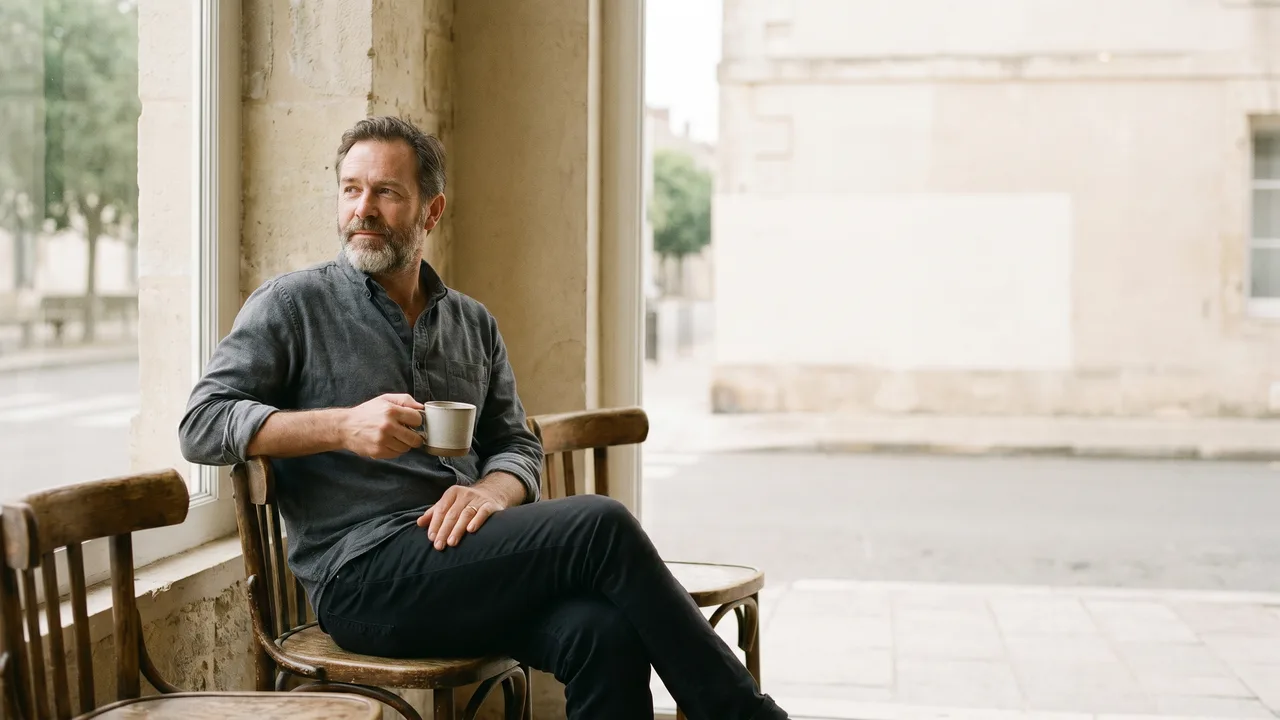
There are real situations where a tee works. All of them depend on raising everything around it.
Layered under a blazer or jacket
This is the single most reliable way to make a t-shirt business casual. A plain tee under an unstructured blazer is a recognized smart-casual look — the jacket supplies the structure and intent the t-shirt lacks. Done well, it reads relaxed but deliberate. The keys: a solid, neutral tee with no graphics, a blazer that fits, and good trousers and shoes underneath. Get those right and the outfit is more put-together than many button-down combinations.
In a genuinely casual modern workplace
Some offices — certain tech companies, creative studios, early-stage startups — run a dress code relaxed enough that a premium plain tee with sharp trousers passes as business casual. The signal there is “elevated, not lazy”: the tee has to look intentional. In these rooms a great t-shirt outfit can look more current than an awkward shirt-and-slacks combination.
When everything else is elevated
The pattern across both cases: a t-shirt becomes business casual when it’s the most casual element in an otherwise dressed-up outfit. Tailored trousers, a clean leather shoe or a sharp sneaker, maybe a watch, and a premium tee — the surrounding pieces pull the whole look up. The moment the rest of the outfit is also casual, the tee drags everything back to plain casual.
A simple test before you walk out: imagine removing the t-shirt from the outfit and replacing it with a plain button-down. If the rest of what you’re wearing would still look business casual with a shirt in its place, the tee is being properly supported and can ride along. If swapping in a shirt would leave you looking underdressed anyway, the problem was never the tee — the whole outfit is too casual, and no top will fix it.
What separates a “business casual” tee from a regular one
Not all t-shirts are equal here. Four things decide whether a tee can play up:
- Fabric and weight. A heavier, premium cotton (or a quality blend) that holds its shape and isn’t see-through. Thin, flimsy, baggy-after-one-wash tees look cheap and can’t be elevated.
- Fit. Clean and trim — following the body without clinging, ending around mid-fly at the hem, sleeves that sit on the upper arm without flapping. Neither baggy nor painted-on.
- Color. Solid and neutral: white, black, gray, navy, olive. These read intentional. Bright colors and tie-dye don’t.
- No graphics or logos. This is non-negotiable for the office. A slogan, band logo, or large brand mark instantly makes a tee casual. Plain is the whole point.
A crew neck is the safe default. A clean V-neck can work if it’s shallow; a deep V leans too going-out. Get all four right and you have a tee that can be dressed up — get any wrong and you don’t.
The fabric point deserves emphasis because it’s the one most men underrate. A cheap tee betrays itself in ways that have nothing to do with how it’s styled: the neckline goes wavy after a few washes, the fabric thins until your skin shows through, and the shape collapses into a shapeless sack. None of that can be rescued by a blazer. A heavier, denser knit holds a clean line at the neck and hem, drapes instead of clinging, and keeps looking deliberate through a full day of wear. If you’re going to lean on a t-shirt for business casual at all, this is where the money goes.
How to wear it so it works
- Pair up, never down. Tailored trousers or clean dark chinos, not joggers or distressed jeans. The trousers do a lot of the work.
- Mind the shoes. Good leather shoes, loafers, or clean minimal sneakers. Scuffed casual shoes sink the look.
- Add a layer. The blazer or an unstructured jacket is what most reliably tips a tee into business-casual range. A fine-gauge cardigan or overshirt can do similar work.
- Keep it clean and crisp. A tee with no stretched neck, no pilling, no fading. A tired t-shirt reads tired no matter what’s around it.
When to skip the t-shirt entirely
Be realistic about the rooms where a tee won’t fly, layered or not:
- Traditional, corporate, or client-facing offices. The expectation is a collar; a t-shirt undercuts it.
- Conservative industries — law, finance, and the like — where even the casual end runs dressier.
- Any meeting where you want to read as senior or authoritative. A tee skews young and relaxed.
- Anywhere the dress code is “business casual” with no signs that the bar has been relaxed. When in doubt, the t-shirt is the wrong gamble.
In all of these, the move is up one rung: a clean dress shirt worn casually — collar open, no tie, sleeves rolled — gives you nearly the same comfort and ease while clearly clearing the business-casual bar. It’s the safer, more flexible choice almost every time.
The bottom line
A t-shirt is not business casual on its own. It becomes business casual only when it’s the most relaxed piece in a deliberately elevated outfit — a premium, plain, well-fitting solid tee, layered under a blazer or worn with tailored trousers and good shoes, in a workplace relaxed enough to allow it. Strip the quality, the fit, the neutral color, or the surrounding pieces, and it slides right back to plain casual. When you’re not sure, reach for a collar instead — it’s the answer business casual was really asking for.