The short answer, and why it is not that simple
Yes, you can often wear jeans for business casual. The honest qualifier is that “often” is doing a lot of work in that sentence. Whether denim reads as business casual depends almost entirely on two things you control and one you do not: the jeans themselves, the rest of the outfit, and the specific culture of your workplace.
If you have searched some version of “can business casual men wear jeans” or “are jeans acceptable for business casual,” you are not overthinking it. Jeans sit right on the line between dressed and undressed, which is exactly why the question keeps coming up. The right pair, styled well, passes cleanly in most relaxed offices. The wrong pair undercuts an otherwise sharp outfit instantly.
This piece sorts out which is which, so you can stop guessing.
What business casual actually asks of your bottoms
Business casual is less a fixed list than a target: pulled together, but not formal. The bottoms have to look deliberate. They should hold a clean line, fit properly, and avoid anything that reads as workwear or weekend wear.
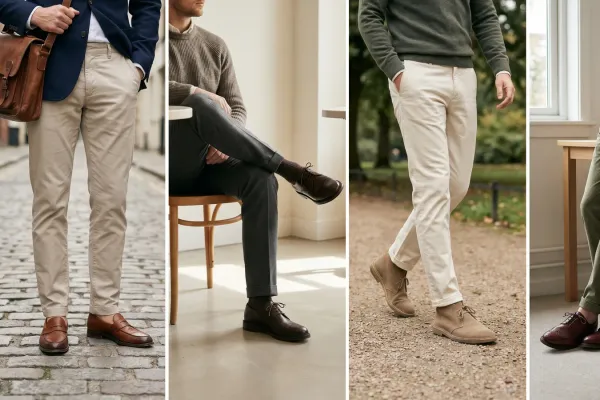
Traditional dress trousers clear that bar by default. Chinos clear it easily too, which is why they are the genre’s reliable backbone. (Our Bottoms & Footwear guide walks through the full range.) Jeans can clear it, but they have to be argued for, because denim carries casual associations that a wool trouser does not.
So the real question is not “are jeans allowed” in the abstract. It is “does this pair, worn this way, look as considered as the chinos it is replacing.” When the answer is yes, jeans are fine. When the answer is no, no dress code reading will save them.
The denim that works, and the denim that does not

The single biggest factor is the jeans themselves. Get this right and most of the battle is over.
What reads as business casual:
- Dark washes. Deep indigo, dark slate, and near-black sit closest to a dress trouser. From a few feet away they can almost pass as one, which is the whole point.
- Clean, untreated denim. No rips, no holes, no heavy fading, no sandblasting or whiskering at the hips. The fabric should look like fabric, not like a styling project.
- A trouser-like cut. Straight or slim-straight legs with a clean line down to the shoe. Skinny jeans read trendy; baggy or relaxed jeans read weekend.
- A proper fit. Tailored through the seat and thigh without being tight, and hemmed so they break neatly over the shoe rather than pooling at the ankle.
What pushes jeans out of bounds:
- Light or medium-light washes
- Visible distressing, rips, or fashion fading
- Loud stitching, large logos, or decorative back-pocket designs
- Overly tight or overly baggy cuts
A useful test: the more a pair of jeans looks like a dark trouser at conversational distance, the more confidently it belongs in a business casual rotation. Dark, clean denim is the safe lane. If you want to go deeper on washes and styling, our piece on blue jeans in business casual breaks down the specific call.
The other half of the outfit
Jeans rarely fail on their own. They fail when they are the most casual thing in an outfit that was already casual everywhere else. Denim plus a graphic tee plus sneakers is just casual. Denim plus a collared shirt and leather shoes is business casual.
The principle is straightforward: when you wear jeans, dress everything around them up to compensate. Practical pairings:
- A dark jean with an oxford-cloth button-down and leather loafers
- A dark jean with a fine-gauge sweater over a collared shirt
- A dark jean with a knit polo and clean leather sneakers
- Any of the above with a blazer, which raises the whole outfit a full notch
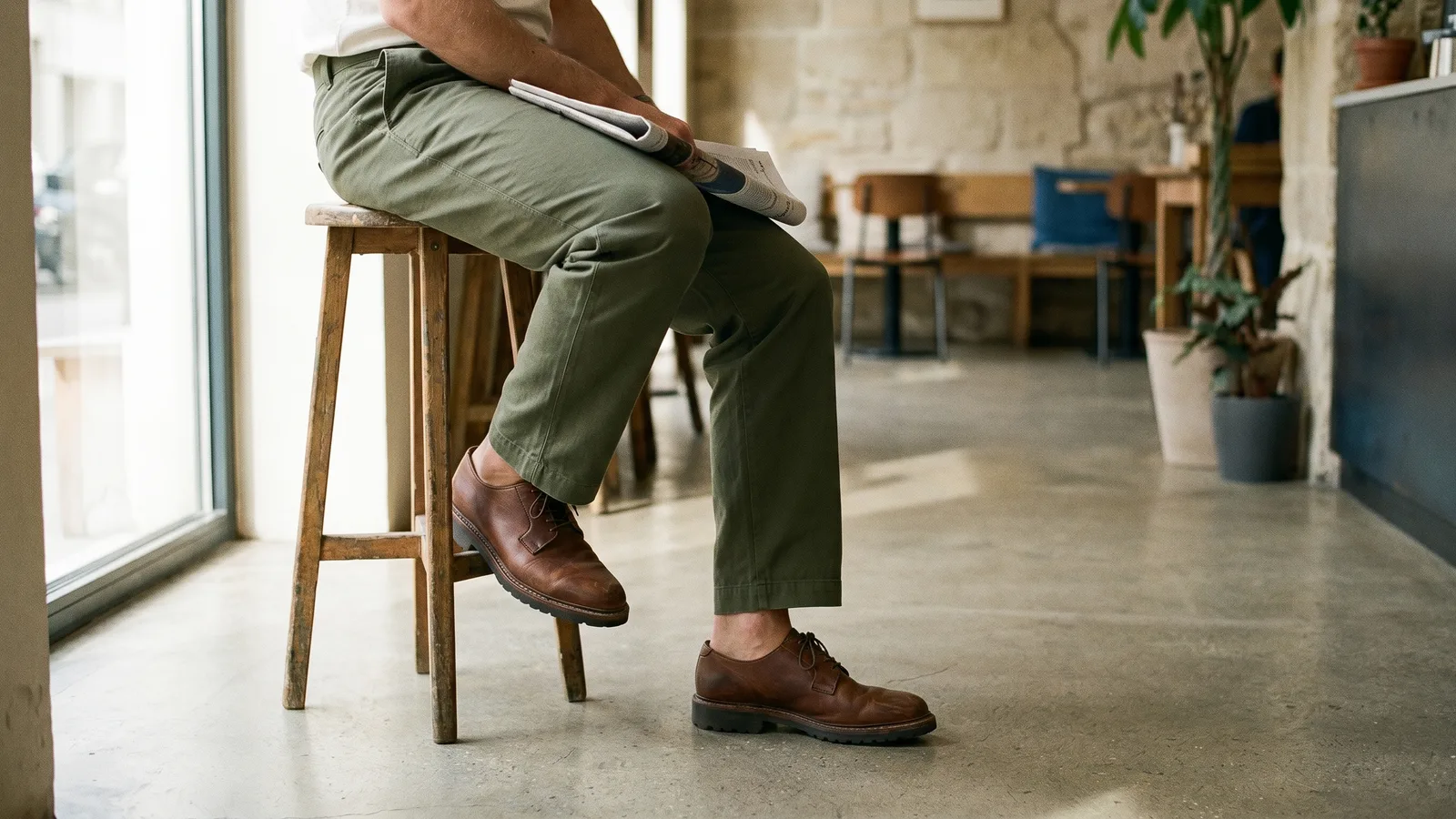
Footwear does a lot of the work here. Leather shoes — loafers, derbies, chukka boots — signal intent immediately. Clean minimalist leather sneakers can work in more relaxed offices. Running shoes and chunky athletic trainers undo the effort. The Bottoms & Footwear pillar covers shoe choices in detail.
The mental model: in a denim outfit, the jeans should be the most casual element present, with everything else clearly dressed up. If the jeans are tied for most casual with your shirt and your shoes, the outfit reads casual, not business casual.
Read the room before you read the rules
Here is the part no styling guide can decide for you. Workplaces define business casual differently, and denim is the single most variable item in the entire category.
In a tech company, a startup, a creative agency, or a relaxed modern office, dark clean jeans are often unremarkable — even expected. In law, finance, consulting, government, and other traditional fields, “business casual” frequently still means no jeans at all, and a dark wash will not change that. Some dress codes say “business casual, no jeans” explicitly, which removes the ambiguity entirely.
How to read your specific environment:
- Look up, not sideways. Watch what people a level or two above you wear, especially anyone client-facing. Their choices tell you the real ceiling, not your peers’ choices.
- Take the written code literally. If it says no jeans, it means no jeans, dark wash or not.
- Mind the occasion. A normal Tuesday and a client presentation are different days. Denim that is fine at your desk may be wrong in the room.
- When genuinely unsure, ask. A direct question to a manager beats guessing wrong on a day that counts.
A reasonable default: if you are new, uncertain, or about to be in front of clients, skip the jeans and reach for chinos or trousers. Save the denim for the days and rooms where you already know it lands.
The reliable alternative when jeans feel risky
When you want the ease of jeans but cannot risk reading too casual, chinos are the answer almost every time. They offer the same relaxed, no-fuss feel, but they sit unambiguously inside business casual in nearly every workplace. A pair of well-fitting chinos in navy, stone, or olive is the lowest-risk bottom in the category — which is exactly why it is the genre’s default.
There is no shame in defaulting to chinos and treating jeans as the upgrade you reach for once you know the room. That is the smart order of operations, not a compromise.
The bottom line
Can you wear jeans for business casual? Usually yes — if the jeans are dark, clean, and well-fitting, if the rest of the outfit is clearly dressed up around them, and if your workplace tolerates denim in the first place. Miss any of those three and the answer flips to no.
Start with a dark, untreated, trouser-cut jean. Build a deliberately dressed outfit around it. Confirm your office actually allows denim before you wear it on a day that matters. Do those three things and jeans become a flexible, low-effort option rather than a gamble. Skip any of them and a pair of chinos will always serve you better.