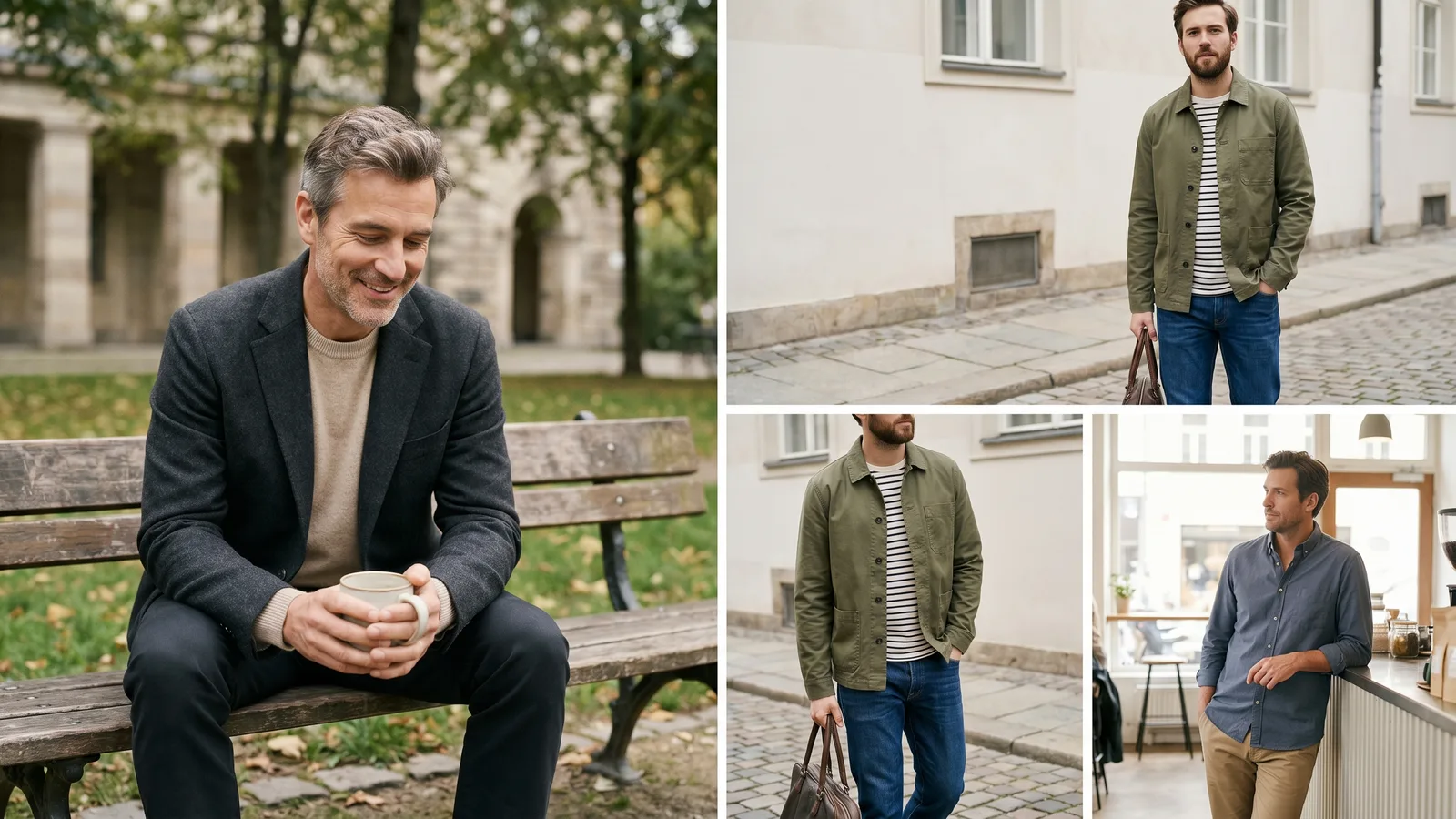
Where smart and casual actually meet
“Smart casual” sounds like a contradiction, and that is precisely why it confuses people. It asks you to be two things at once, polished and relaxed, without tipping fully into either. Get the balance right and you look effortlessly pulled together. Get it wrong and you look stuck between two ideas.
The trick is understanding that smart and casual are not fighting each other; they are dividing the work. One half of your outfit carries the “smart,” structure, sharpness, good materials, and the other half carries the “casual,” ease and comfort. Once you see it that way, the dress code stops being a riddle.
This guide explains how the two halves meet, how smart casual differs from its close cousin business casual, and how to build outfits that land in the right place. It sits alongside our business casual fundamentals hub and our breakdown of business casual attire, which cover the workplace-anchored version of the same territory.
Smart casual versus business casual
The two overlap heavily, and a single outfit can satisfy both, but they are not identical, and knowing the difference keeps you from misjudging an invitation.
Business casual is tied to the workplace. It has a professional baseline, collared shirts, chinos or dress trousers, clean leather shoes, and a fairly predictable range. Its job is to look competent and appropriate in an office. Our practical starting point for men’s business casual lays out that foundation in full.
Smart casual is broader and more social. It travels beyond the office to dinners, daytime events, and gatherings where you want to look considered but not corporate. It permits more personality, texture, color, the occasional pair of sharp jeans, as long as the overall effect still reads as deliberate. Where business casual asks “is this appropriate for work,” smart casual asks “do I look like I put thought into this.” The practical upshot: smart casual can flex slightly dressier or slightly more relaxed than business casual, depending on the occasion.
The balancing principle: one half smart, one half casual
The most useful way to build a smart casual outfit is to anchor it with one sharp element and let the rest relax around it. You are aiming for contrast that resolves, not an outfit that is uniformly dressy or uniformly slouchy.
A few combinations that work because the balance is right:
- A blazer with dark jeans. The blazer supplies the structure; the jeans keep it from reading formal. Finish with leather shoes or clean boots.
- A crisp collared shirt with chinos and minimal sneakers. The shirt and trousers do the smart work; the sneakers keep it relaxed.
- A fine knit sweater over a collared shirt with tailored trousers. Quietly sharp, with the soft knit pulling it back from formal.
The principle holds in reverse too. If your top half is very relaxed, a plain tee, then your trousers, shoes, and any layer need to do the lifting. If both halves go casual, you have left smart casual entirely and landed in weekend clothes.
Building blocks of smart casual wear
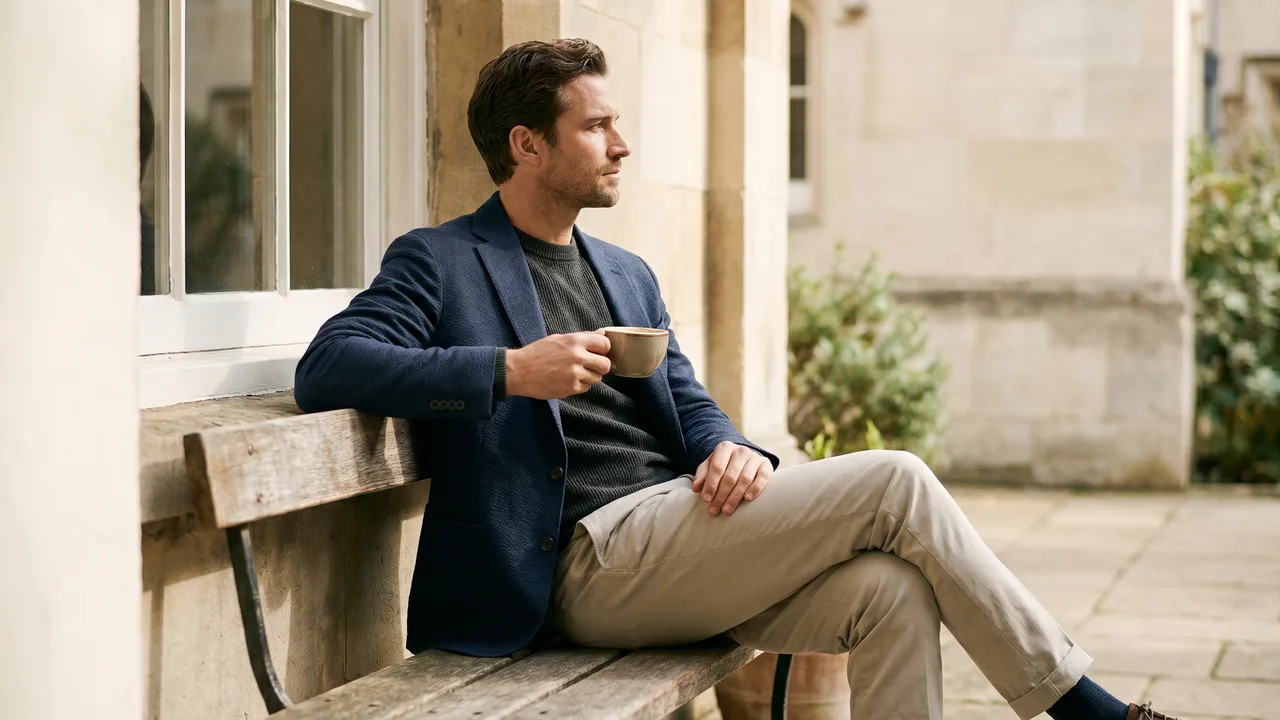
You do not need a separate wardrobe for this. Smart casual is built from the same neutral, well-fitting pieces that serve business casual, just assembled with a bit more freedom.
Tops. Collared shirts and fine knits are the backbone. A knit polo, an Oxford button-down, or a merino crewneck all read smart casual cleanly. A plain tee can work only as a layer under a jacket, never as the whole story.
Bottoms. Tailored chinos are the safe center; dark, clean jeans are the casual lever you can pull when the setting allows. Wool trousers tip the outfit dressier when you want it.
Layers. An unstructured blazer is the highest-leverage smart casual piece you can own, instant polish over almost anything. A casual overshirt or a quiet bomber can supply the same structural role in more relaxed settings.
Shoes. Clean leather, loafers, derbies, chukka boots, anchors the smart end. Minimal leather sneakers anchor the relaxed end. Both are legitimate; choose based on how dressy the occasion runs.
Texture and color do the quiet work
Once the silhouette is right, texture and color are what make smart casual feel intentional rather than plain. This is where the dress code gives you a little more room than a strict office setting would.
A textured knit, a brushed cotton, a soft flannel, or a subtle pattern adds interest without shouting. Color can warm up too: an olive jacket, a rust knit, a deeper blue, used in small, considered doses against a neutral base. The discipline is the same as everywhere else in good menswear, keep the foundation quiet so a single richer element reads as a choice rather than noise.
Reading the occasion
Because smart casual travels well beyond the office, the same label can mean slightly different things depending on where you are headed, and reading the occasion is half the skill.
A smart casual dinner or evening event runs toward the dressier end, lean on the blazer, a collared shirt, dark trousers or clean jeans, and leather shoes. The setting and the lower light reward a sharper outfit. A daytime gathering or weekend social runs more relaxed, a knit polo or Oxford with chinos and clean sneakers is comfortably enough. A smart casual workplace, where some offices use the term instead of business casual, sits closest to the professional baseline; treat it the way you would the dressier reading of business casual.
When an invitation says smart casual and gives no other clue, the safe instinct is the same one that serves everywhere in menswear: aim a touch sharper than you think you need, because it is far easier to relax a look on arrival, slip off a jacket, than to add polish you did not bring. A blazer you can remove gives you that flexibility built in.
Footwear is the deciding vote
In smart casual more than almost any other register, the shoes settle where the outfit lands. The same shirt and trousers read noticeably dressier with leather loafers than with sneakers, which makes footwear the easiest lever to pull once everything else is set.
Keep two ends covered. Clean leather, loafers, derbies, or chukka boots, pulls an outfit up and is the right call when the occasion runs dressy or you are unsure. Minimal leather sneakers in white or a neutral pull it down just enough to keep a sharp outfit from reading formal, which is often exactly the smart casual sweet spot. Either way the shoe must look chosen and cared for; a scuffed or chunky athletic shoe drags the whole effort down regardless of what is above it. When you cannot decide how dressy to go, decide it at the feet and build the rest to match.
Common ways men miss the mark
Smart casual goes wrong in two predictable directions.
The first is overshooting, wearing what is effectively a suit minus the tie and looking stiff and overdressed for a relaxed occasion. If everything is sharp and nothing is relaxed, you have missed the casual half. Swap the dress trousers for chinos or the dress shoes for clean sneakers, and the outfit breathes.
The second is undershooting, treating “casual” as permission to wear weekend clothes and forgetting the smart entirely. A tee, shorts, and trainers is not smart casual; it is just casual. The fix is to introduce one deliberate, structured element, a collared shirt, a blazer, real shoes, that signals thought.
The sweet spot is the same one that makes all good dressing look easy: a small, well-fitting, neutral wardrobe, assembled so that one half stays sharp and the other stays relaxed. Get that balance, keep everything clean and pressed, and smart casual stops being a puzzle and becomes one of the most useful registers a man can dress in.