Getting business casual attire right, piece by piece
Most advice on business casual attire stops at vague reassurance: “dress professionally but relaxed.” That is not much help when you are standing in front of the closet. The useful version is specific, garment by garment, what earns its place and what quietly drags a look down.
This is that breakdown, from the shirt to the shoes. Where our practical starting guide to men’s business casual covers what to buy first, this page is about wearing it well: the details that separate attire that merely passes from attire that looks genuinely considered. For the wider context, the business casual fundamentals hub ties the whole topic together.
Tops: collars, knits, and the t-shirt question
The top sets the formality of the whole outfit, so it is worth getting right.
Collared shirts are the safe center of the category. An Oxford cloth button-down is the most versatile, dressy enough with a blazer, casual enough on its own. Dress shirts in poplin read sharper and are right for client-facing days. Keep patterns quiet: solids, a fine stripe, or a small check.
Knit polos and fine sweaters are the underrated workhorses. A merino crewneck or quarter-zip over a collared shirt is one of the most reliably good looks in business casual, and a knit polo bridges the gap on warmer days without dropping to t-shirt territory.
The t-shirt is where men go wrong most often. A plain tee on its own is too casual for nearly all offices. It can work as a layer under a blazer in genuinely relaxed, creative settings, but as a standalone top it pulls the outfit below the line. If you want collarless comfort, reach for a fine knit instead.
Skip: graphic tees, hoodies, anything with a visible logo across the chest, and shirts so wrinkled they look slept in.
Bottoms: trousers that do the quiet work
Your trousers carry the outfit even though no one comments on them.
Chinos are the everyday answer, flat-front, in a tailored straight or slim-straight cut. Khakis are the central case here, and because the fit and styling have specific traps, we cover them fully in our guide to business casual khakis.
Dress trousers in wool or a wool blend are the step up. They drape better than cotton, hold a crease, and pair naturally with a blazer when you want to look sharper.
Dark jeans occupy a gray zone. In relaxed offices, a clean, dark, unwashed pair with no rips or fading can pass, especially with a button-up and leather shoes. In traditional environments they still read as too casual. Read your workplace before relying on them.
Skip: cargo trousers, anything with a sporty drawstring, shorts in most offices, and trousers that pool over the shoe. The break, where the hem meets the shoe, should be slight: a small fold, not a stack of fabric.
Layers: the blazer and the knit
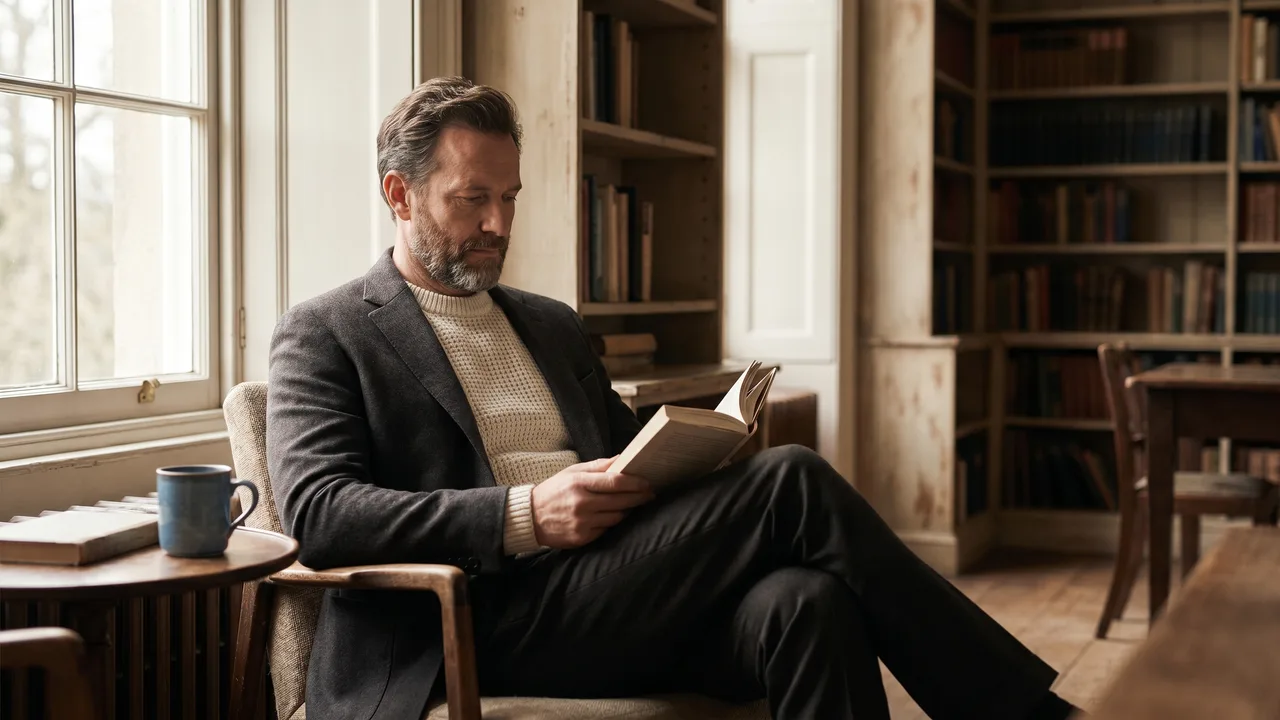
Layering is what gives business casual its range. The same shirt and trousers can move up or down the formality scale depending on what you add on top.
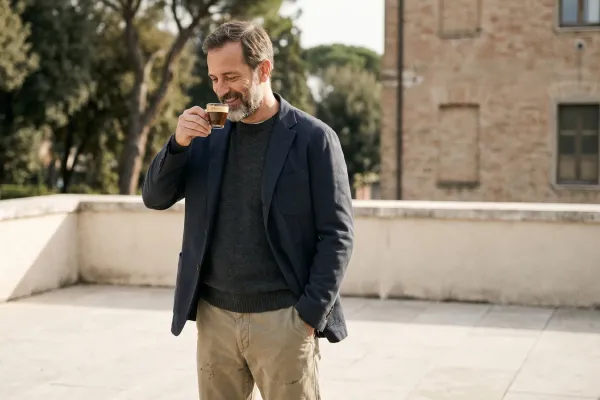
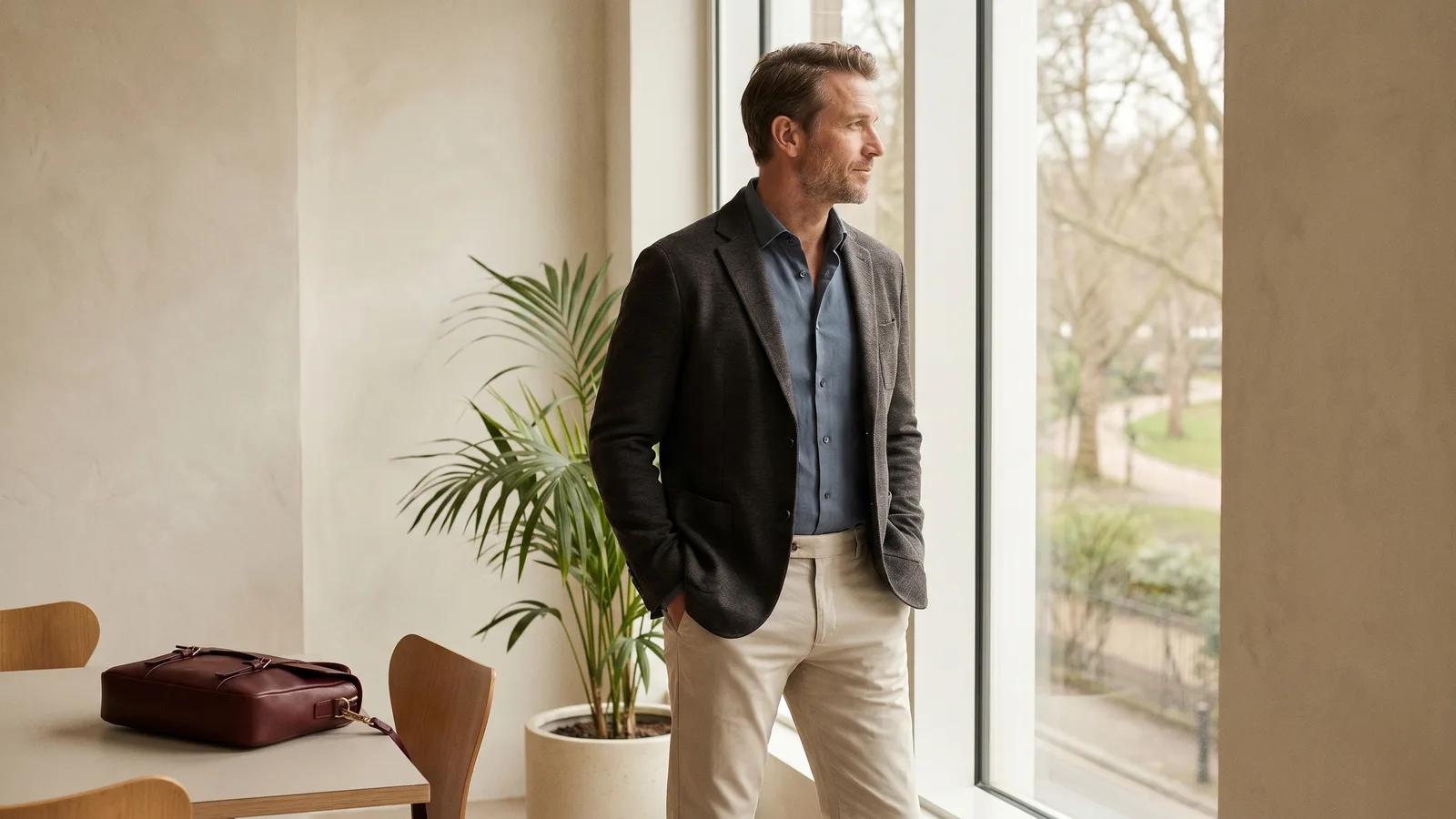
An unstructured blazer, navy first, is the single most effective layer you can own. Soft shoulders and little padding keep it from looking like a stranded suit jacket. Over a shirt and chinos, it makes almost any room read as “best dressed without trying.”
A sweater does similar work more quietly. A crewneck or quarter-zip over a collared shirt looks intentional and handles the cooler half of the year.
The key with layers is that they should look chosen, not piled on. One considered layer beats two competing ones.
Shoes and belt: where the eye lands
People notice shoes, often without realizing it, and a good outfit with bad shoes reads as a bad outfit.
Leather is the foundation. Brown derbies and loafers are the most versatile; brogues and chukka boots extend the range. Clean, minimal leather sneakers, white or a neutral tone, pass in many modern offices, particularly when the rest of the outfit is tailored. Whatever you choose, keep it clean and polished. Scuffed shoes are the fastest way to look careless.
Match your belt to your shoes in the same broad color family. Brown shoes, brown belt. Black shoes, black belt. It is a small rule, but the eye registers a mismatch immediately.
Skip: athletic running shoes, heavily branded sneakers, and most sandals.
Accessories: small things, real difference
Accessories are where business casual attire goes from adequate to considered, and where it can also quietly go wrong. The rule is restraint. A few well-chosen items add finish; a pile of them adds clutter.
A watch is the one accessory almost any man can wear without thinking, a simple leather-strap or steel watch reads as quietly competent. Socks should generally disappear into the trousers or the shoes, matching one or the other, with patterned socks saved for the rare occasion you want a small, deliberate flash of personality. A belt is functional first: match it to your shoes and keep it in good condition, since a cracked or frayed belt undercuts everything above it.
For dressier business casual days, a knit tie is the easiest way to look sharper without tipping into full formal, its texture keeps it relaxed where a silk tie would read corporate. Beyond that, less is more. Skip loud jewelry, novelty cufflinks, and anything that competes for attention with the outfit itself.
Putting it together: reliable outfit formulas
The fastest way to make business casual effortless is to keep a few proven combinations in your head so getting dressed becomes assembly rather than invention. A handful of examples, from most relaxed to sharpest:
- The everyday baseline. Oxford button-down, tan chinos, brown leather loafers. Untuck the shirt on relaxed days, tuck it when you want a cleaner line. This is the outfit you can wear most days without a second thought.
- The cool-weather standard. Merino crewneck over a collared shirt, gray chinos or wool trousers, leather boots. The knit does the dressing-up while staying comfortable.
- The sharpen-up. Navy unstructured blazer over a light blue dress shirt, gray trousers, brown derbies. This is your client-meeting and important-day look, built from the same wardrobe as the baseline.
- The relaxed-office Friday. Knit polo, dark clean chinos, minimal white leather sneakers. Comfortable and easy, but still clearly a step above weekend clothes.
Notice that these share most of their parts. That is the point: a small neutral wardrobe recombines into every register you need, which is exactly why fit and quality matter more than quantity.
Fit and upkeep: the part that actually matters
You can own every right piece and still look sloppy if the fit and condition are wrong. These two factors do more for your appearance than any single garment.
Fit is non-negotiable. A shirt should follow your shoulders and trunk without billowing; trousers should sit at the waist without sagging or straining. If something fits poorly off the rack, a tailor can usually take in a shirt or hem a trouser for less than the price of replacing it. This is the cheapest upgrade available.
Upkeep is the other half. Pressed shirts, clean shoes, an unfrayed belt, these signal competence whether or not anyone consciously notices. Wrinkles and scuffs signal the opposite. Caring for a small wardrobe will always beat neglecting a large one.
Reading the room
“Business casual” covers a wide range, and the same outfit can be perfectly judged in one office and slightly off in another. Calibrate by watching how the respected mid-level people around you dress, not the most casual person and not the executives.
If you are new or unsure, lean a notch sharper for the first week, then ease off once you have read the room. For the broader framing of where business casual sits relative to dressier and more relaxed codes, our overview of men’s business casual lays out the full picture. Get the foundation and the fit right, keep it clean, and the attire takes care of itself.