How to read this list
This is the shopping side of a capsule wardrobe: the specific garments, in specific counts and colors, that cover a full business casual week. Everything here is chosen to coordinate, so any top works with any bottom and any layer works over any shirt.
Treat the numbers as a floor, not a cap. The goal is the smallest set that still produces dozens of outfits. Buy in the colors listed and the coordination takes care of itself; stray from the palette and you’ll need more pieces to get the same number of working combinations.
A note on order: if you can’t buy everything at once, work top to bottom. The earlier categories do the most work.
One organizing idea sits behind the whole list: counts follow how often a category gets worn and how visible it is. You wear one pair of trousers all day, so a few good ones matter more than many cheap ones; you cycle through shirts faster, so you carry slightly more of them. The list isn’t arbitrary — it’s weighted toward the pieces that earn their keep.
Tops: 4–6 pieces
This is where men tend to over-buy, so keep it tight and varied rather than deep.
- 2 dress shirts — one white, one light blue. These are the most formal tops you’ll own and the most flexible. See our dress shirt guide for fit and fabric details.
- 1–2 casual button-ups — an oxford-cloth button-down in white or blue, optionally a second in a subtle check or chambray.
- 1 polo — solid, in navy or a muted tone, in a substantial knit rather than a thin athletic fabric.
- 1 fine-gauge knit — a crew-neck sweater or long-sleeve merino in gray or navy that can be worn alone or layered over a collar.
Keep tops a step lighter than bottoms. Lighter-on-darker contrast happens automatically and always looks deliberate.
Why this spread rather than, say, six dress shirts? Because range beats depth. Two dress shirts, a casual button-up, a polo, and a knit give you five different formality levels from one small group; six dress shirts give you one level repeated. The varied set lets the same trousers read sharp on Monday and relaxed on Friday without buying anything new below the waist.
Bottoms: 3–4 pieces
This is where men tend to under-buy, and it’s usually the real bottleneck. A closet full of shirts with one pair of pants produces one look.
- 1 pair chinos, tan or stone — the workhorse. Pairs with every top on the list.
- 1 pair chinos or trousers, navy or charcoal — the dressier of the casual options.
- 1 pair wool or wool-blend trousers, gray — for the days you want to read sharper without a suit.
- 1 pair dark denim (optional) — clean, no fading or distressing, for the most relaxed end of business casual if your workplace allows it.
Match the formality of the trouser to the formality of the top and you’ll never be mismatched.
The reason bottoms are the real bottleneck is simple arithmetic: outfits are tops times bottoms. Eight shirts and one trouser is eight near-identical looks; four shirts and three trousers is twelve genuinely different ones. If your closet feels stale despite being full, the fix is almost always a second and third pair of trousers, not another shirt. Spend here before you spend anywhere else.
Layers: 2 pieces
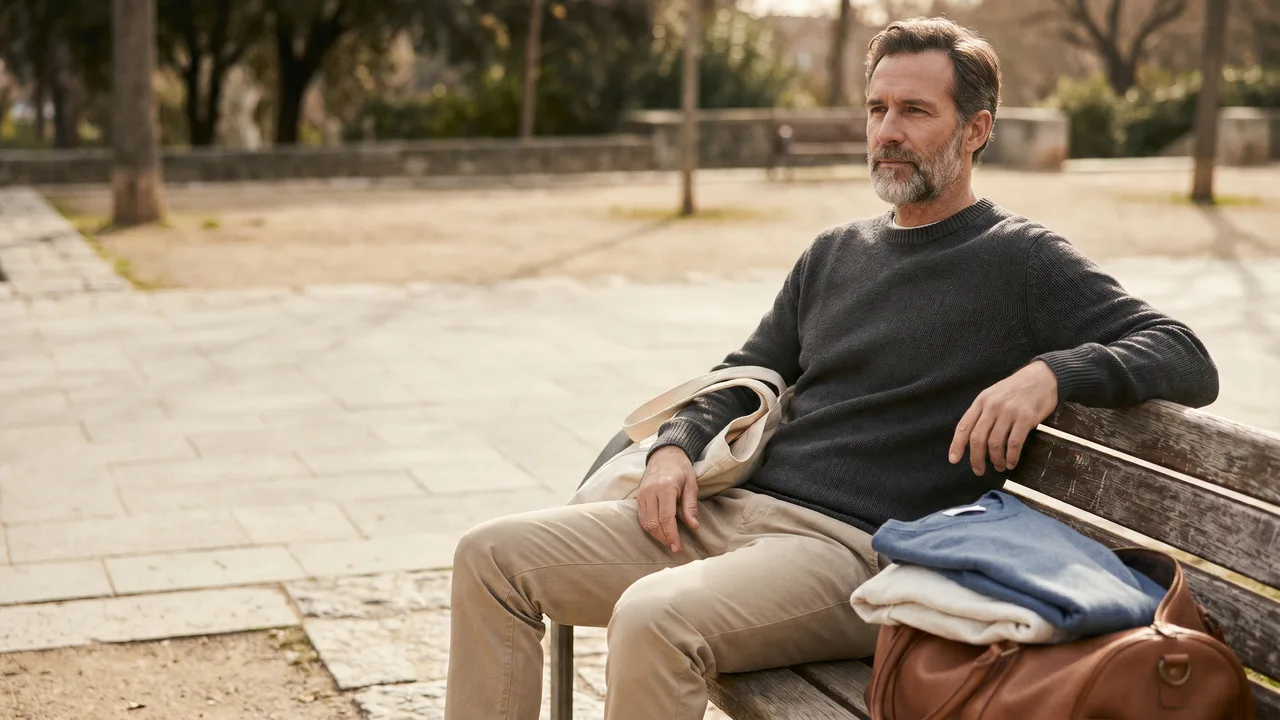
Layers are the force multipliers — they change the register of an outfit without changing the outfit.
- 1 unstructured blazer, navy — the highest-leverage item on the entire list. It elevates any shirt-and-trouser combination instantly.
- 1 versatile knit or overshirt — a cardigan, second sweater, or shirt-jacket in a neutral, for the days a blazer is too much but a shirt alone is too little.
Footwear: 2 pairs
Two well-chosen pairs cover the full dress-up/dress-down range. Our shoe guide goes deeper on each.
- 1 pair leather shoes, brown — derbies or loafers. The dressier anchor; brown is more versatile than black for business casual.
- 1 pair minimal leather sneakers, white or off-white — clean and low-profile, not athletic, for the relaxed end.
Accessories and finishing pieces
Small, but they’re what separate a coordinated outfit from a finished one.
- 1 leather belt, brown — to match the brown shoes. Leather color should agree top to bottom.
- 2–3 pairs of dress socks — in navy or gray, mid-calf, no logos.
- 1 simple watch (optional) — leather or metal band, clean dial.
The rule that governs all of these is agreement, not matching everything to everything. Leathers should harmonize — belt to shoes, and a watch strap that doesn’t fight either. Socks should disappear into the trouser rather than announce themselves. None of this is expensive or complicated, but it’s the layer most men skip, and it’s exactly what reads as “finished” versus “dressed.”
The full count at a glance
Add it up and a complete business casual foundation lands at roughly 13 to 17 garments plus accessories:
- Tops: 4–6
- Bottoms: 3–4
- Layers: 2
- Footwear: 2
- Belt: 1
That’s a five-day week with overlap to spare. Because everything shares a palette, the real outfit count runs into the dozens.
A few seasonal notes keep this list working year-round without inflating it. In summer, lean on lighter cottons and linen-blends and let the polo and oxford carry more days; the blazer goes unstructured and unlined. In winter, the knit and a heavier trouser do more work, and you’ll want to add outerwear on top — a topcoat or a clean field jacket in a neutral — which sits outside this base count but should still respect the same palette. The list is the constant; fabric weight is the variable you adjust.
A week of outfits from the list
To show the list isn’t theoretical, here’s how thirteen pieces cover a varied week without repeating a look:
- Monday, sharp: white dress shirt, gray wool trousers, brown loafers, navy blazer. The most formal end — client meeting or presentation.
- Tuesday, relaxed-professional: blue oxford button-down, tan chinos, brown loafers, sweater over the collar. Polished but unforced.
- Wednesday, easy: navy polo, navy chinos, leather sneakers. Comfortable without reading careless.
- Thursday, layered: light blue dress shirt, gray trousers, brown loafers, knit instead of blazer. A half-step down from Monday.
- Friday, casual: oxford button-down open over a knit, dark denim, leather sneakers. The most relaxed look the list allows.
Five days, five distinct registers, and not one piece bought specifically for one outfit. That’s the list working as designed: range comes from recombination, not from volume.
Buying it without buying all of it
You don’t need this whole list at once. Start with what already fits, then fill the gaps in this order: bottoms first if you’re short on them, then a versatile layer, then footwear, then round out the tops. For the reasoning behind the counts — why the ratio of tops to bottoms matters, and how the multiplication works — see our capsule wardrobe guide, or read our core pieces breakdown for what to look for in each item.